
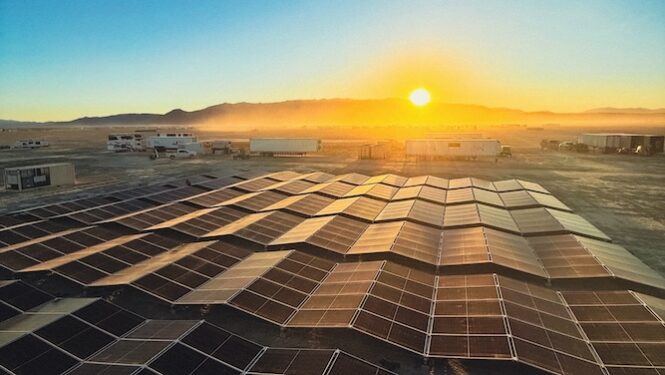
Were you in Black Rock City over the last few years? Did you think it was… quieter? Was there less humming and rumbling as you walked through camps and encountered art on playa? You’d be right! It’s quieter out there and the air is cleaner too, thanks to fewer generators and the addition of solar panels in every city sector.
This didn’t happen by accident. Whether you’ve been following Burning Man’s journey to a more sustainable and regenerative Black Rock City for the last six years or you’re just learning about it now, we’ve got exciting news and progress to share… plus some ways YOU can level up your participation and get involved.
We’re Seeing Real Impacts of Our Collective Work
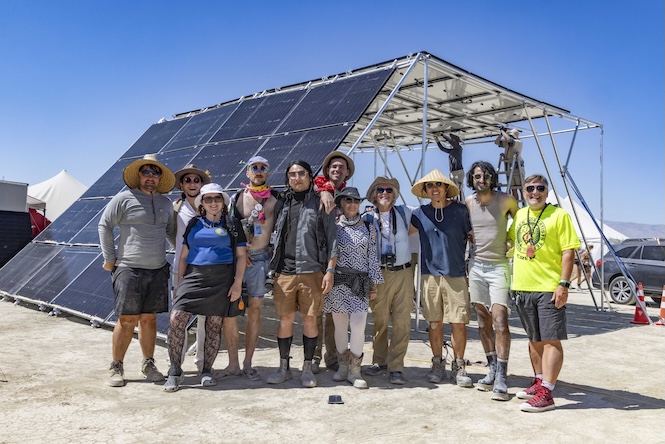
Burning Man, in Black Rock City and around the world, is recognized as a crucible for collaborative innovation. With every year, more Regional Events, artists, camps, and mutant vehicle crews switch to renewable power sources and devise increasingly creative, efficient ways to illuminate their gifts on playa. And year over year, Black Rock City operations — the crews that build and operate the city — are implementing more technology and practices that result in powerful and exciting outcomes.
In Black Rock City 2025, the majority of placed camps had solar panels (59%) and many completely ditched generators (19%). Most of the art installations used solar (63%) and there were a surprising number of electric mutant vehicles (27%). This is incredible news… and there’s more!
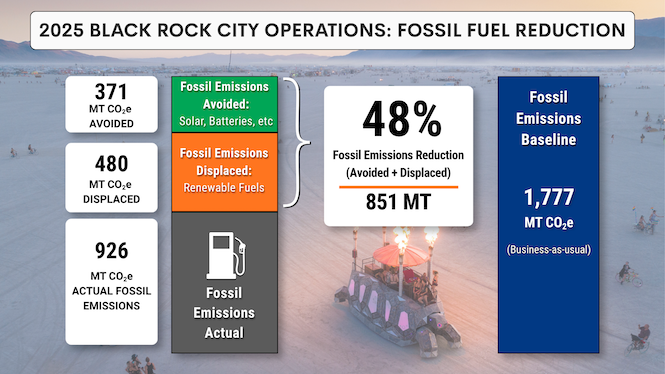
Also in 2025, Burning Man Project’s operations reduced fossil fuel emissions by 48% against a business-as-usual fossil emissions baseline in Black Rock City. Across Black Rock City as a whole, fossil emissions were at least 25% lower than they would have been without solar, batteries, and renewable fuels.
Let’s break that down.
Weather, population, and operational needs have a significant impact on emissions, often making year-over-year comparisons challenging. Burning Man Project’s Regeneration department compared actual fossil emissions to a business-as-usual baseline of what emissions would have been without investments in sustainability initiatives.
The team also completed a comprehensive 2025 BRC Greenhouse Gas Emissions Inventory. Together, these tools measure the emissions produced, the emissions avoided or displaced, and the progress towards our collective goal.
The primary contributor to Black Rock City’s footprint comes from the sheer energy required to run a 70,000-person event; generators and gas appliances accounted for 59% of total emissions in 2025. For years, the constant hum and exhaust of diesel generators have been an accepted reality of the playa. But things are changing fast.
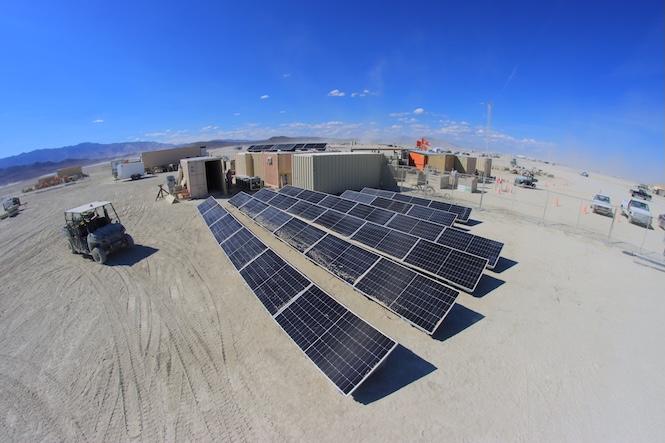
In 2025, Black Rock City’s Power team, Solar team, and its collaborators deployed more than 16 megawatt-hours (MWh) of battery capacity across its power grids and community service camps. Fifteen of the 41 infrastructure grids were solar powered, and most of Burning Man Project’s generator grids were interconnected with batteries.
Instead of running generators 24/7, the batteries supply silent, continuous power, and the generators only kick on to charge the battery banks. This single intervention resulted in a staggering 59% reduction in average generator run-time, saving more than 24,000 gallons of diesel fuel for Burning Man Project’s power grids.
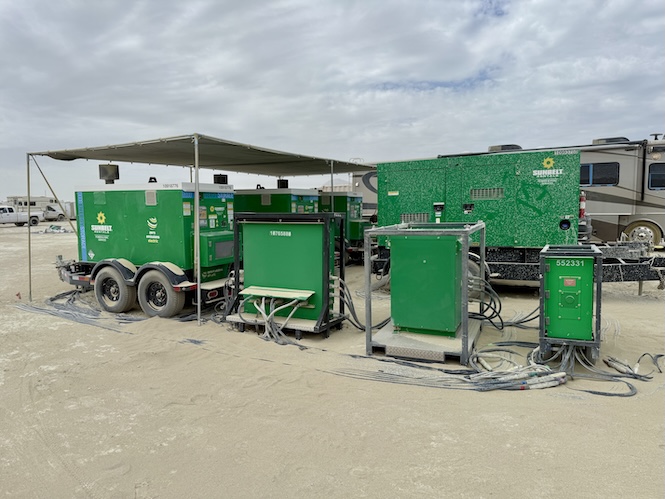
When the generators did need to run, they were fueled differently. Cue renewable fuels. These are certified fuels that come from renewable biomass (think plant and animal waste). Burning Man Project piloted and expanded the use of renewable fuels, successfully replacing 40% of its fossil diesel consumption with renewable diesel.
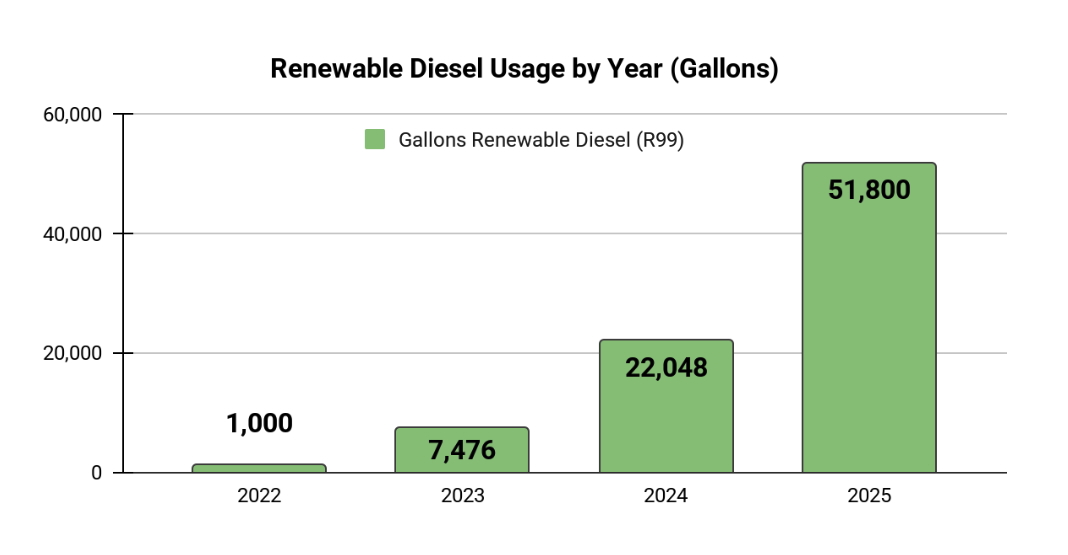 Aside from renewable diesel, 100% of the propane distributed via the BRC Fuel Program and for Burning Man Project’s operations was renewable propane! In total, more than 68,000 gallons of fossil fuels were displaced by renewable fuels across the city.
It is important to note that the processing and transportation of renewable fuels does involve fossil fuels, and these emissions were not included in this analysis. However, making this switch has resulted in a dramatic decrease in our overall carbon intensity and represents a significant step forward in achieving a net-zero city.
More broadly, Burning Man Project encourages legitimate carbon dioxide removal rather than just buying offset credits. A significant number of camps, mutant vehicles and art projects have participated in these programs. The Communal Effort over the past six years, and the resulting data, prove it’s entirely possible to decrease Black Rock City’s carbon impact while still building the vibrant, awe-inspiring city we love. Let’s keep building it better, together!
What’s Next and How You Can Get Involved
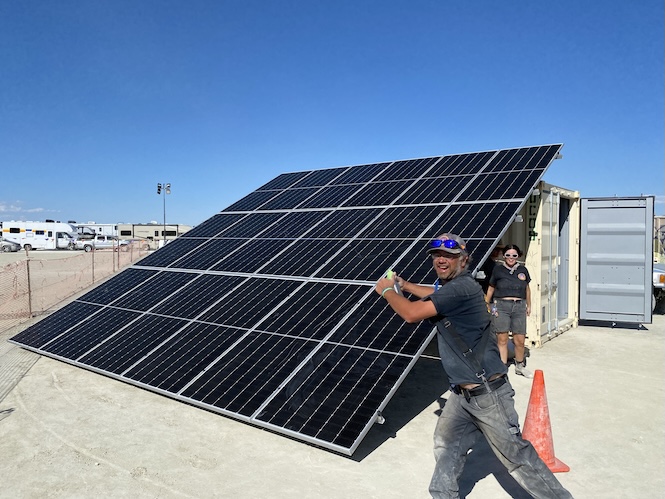
Transitions like these occur because people like YOU come together to imagine, experiment, and innovate together. Participants’ collective learnings extend to Regional Events, and are applied to renewably power creative, technological, and humanitarian projects well beyond Burning Man. You do not need to be an expert; you simply need to have the inspiration and curiosity to try new things, find others and get involved.
If you’re headed to Black Rock City this year, here are some impactful ways your camp or project can participate:
Opt for Renewable Fuels: Registrants in the BRC Fuel Program can source renewable fuels for your camp. If you’re coming from California, renewable diesel is commercially available at gas stations.
Charge Renewably: If you operate an electric mutant vehicle or e-bike, plan to charge it on 100% renewable energy on the playa at Solar Station. Bring your own charger to ensure compatibility or email hello@solarpunks.club for more information.
Get Free Solar Panels and Support: The Renewables for Artists Team (RAT) is actively offering on-playa support and mentorship to power art installations, camp projects, and mutant vehicles renewably. They’ve partnered with Burning Man Project to provide free solar panels for pick up in Black Rock City.
Plan Greener Infrastructure: Consult the Green Theme Camp Community’s Green Resource Guide for best practices on building more sustainable and regenerative camp infrastructure.
Track Fuel Consumption: Fill out the emissions survey to contribute to the emissions inventory project. This survey is emailed to camp and sustainability leads of placed camps post-event.
Donate: Financial contributions directly help scale these crucial renewable energy and battery initiatives across Black Rock City. Email giving@burningman.org to learn more, or head to donate.burningman.org.
As always, we welcome your thoughts and your creativity. If you want to contact us, send an email to sustainability@burningman.org.
Cover image: SOLAR STATION, Black Rock City’s largest power grid deployed by Camp SOLARPUNKS (Photo Credit: SOLARPUNKS, 2025)

FYI: The AEZ (Alternative Energy Zone), one of the oldest still existing villages at BM, has been promoting solar etc. since 2000, educating many 100s of members and visitors (e.g. during the scheduled tours during the event).
Report comment
Maybe stop burning carbon all over the place.
Report comment
This is good to know. I’ve been concerned about the amount of carbon that is produced at Burning Man every year. Obviously, all the kerosene alone that is ignited on Saturday night is a stunning display of consumption. I am happy to learn that the org is coming up with creative ways to reduce the carbon footprint of the event while still burning the man.
Report comment
What stands out about the race to decarbonize black rock city in this post is that it acknowledges the variation in difficulty across years, which a lot of generic prep advice ignores entirely. The section on we’re seeing real impacts of our collective work is where most aspirants actually lose marks, not on the concepts they have studied. One thing worth mentioning for anyone reading this mid-prep: the studio test or situation test component often gets under-practised because there is less structured material available for it. Spending time on that specifically in the last two months tends to have a disproportionate impact on the final score.
Report comment
Comments are closed.