


TL;DR
2025 was challenging. Early event-week rain and wind created tough MOOP conditions across Black Rock City. True to form, the Black Rock City community rebuilt, had a Burn, and cleaned up — followed by the 150-person Playa Restoration crew (Resto). Together, we once again passed the Bureau of Land Management’s Post-Event Inspection, staying under the one-square-foot-per-acre standard limit (under 0.002% MOOP). One clear word of warning from Resto: more than 2,000 lag bolts were still left anchored into the playa. Lag bolts remain the most serious recurring MOOP issue, and the primary focus for improvement as we come together for Axis Mundi 2026.

Burning Man’s Leaving No Trace Principle
One of the 10 guiding Principles of Burning Man, Leaving No Trace, states:
“The Burning Man community respects the environment. We are committed to leaving no physical trace of our activities wherever we gather. We clean up after ourselves and endeavor, whenever possible, to leave such places in a better state than when we found them.”
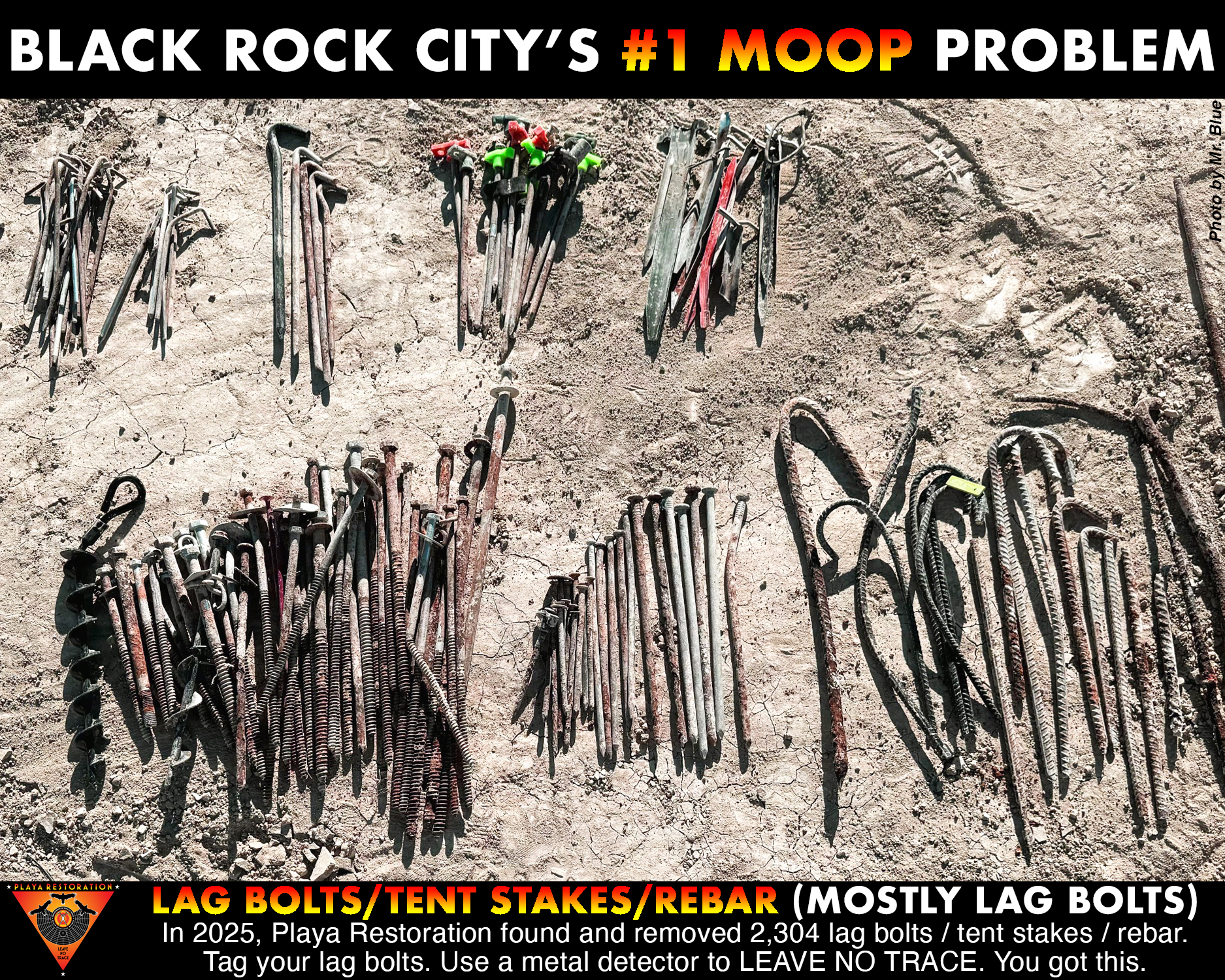
Community Problem Solving: The #1 Worst MOOP — Lag Bolts / Tent Stakes / Rebar (But Really Lag Bolts)
While we initially hoped lag bolts were just a temporary rising MOOP trend back in 2022, three consecutive years at #1 Worst MOOP tells a different story. Lag bolts are a problem that the Black Rock City participants must solve. The good news: it ain’t rocket science.
Defining the Lag Bolt Problem
Lag bolts are highly effective for anchoring objects into the playa. But when screwed flush into — or below — the surface, they disappear into the dust. Overlooked, they become both a leave no trace failure and a safety hazard for vehicles and people.
Resto’s MOOP data shows something important about the problem. This isn’t about a few camps missing many lag bolts — the problem is that many camps are missing a few. Across Black Rock City’s 157 million square feet, those small, easy-to-miss lag bolts — often no larger than half an inch at the surface — added up to 2,304 lag bolts in 2025.
If you have developed reliable techniques for managing and recovering lag bolts, we welcome those solutions in the comments. Shared practices help the community get stronger at Leaving No Trace.
So what are the not-rocket-science solutions?
Lag Bolt Finding Solutions
- Visibly tag your lag bolts when you screw them in so they’re easy to locate and unscrew during breakdown. Use solutions such as marking whiskers, heavy-duty flagging tape, cords, ties, etc., that won’t become MOOP issues themselves.
- Use a metal detector to help ensure no lag bolts or anchors remain hidden beneath the surface.


Leaving No Trace works when the community takes responsibility for the city we build together. Theme camps, art projects, and event infrastructure teams manage spaces ranging from a few hundred to a few thousand square feet, and are responsible for restoring those spaces before they leave. The 150-person Playa Restoration crew, made up of community members like you, stays behind for weeks to inspect and scour roughly 157 million square feet of playa. Resto is not the primary cleanup crew for camps and projects. Our role is to verify, remediate what’s missed, and ensure we meet federal standards.
The scale difference is enormous, but the principle remains the same: the care taken within each camp, project, or infrastructure footprint directly determines the work required to restore the playa, and whether we pass inspection.



MOOP Map 2025: What the Colors Actually Mean
The MOOP Map records cleanup effort and time spent by Playa Restoration crews across Black Rock City.
Clear areas indicate normal forward progress — occasional MOOP, but nothing worth writing home about. Yellow areas reflect moderate MOOP conditions, requiring slower, cautious, stop-and-go movement to avoid missing anything. Red areas represent difficult-progress cleanup conditions that stopped us in our tracks, impeding our momentum as we work to cover the entirety of Black Rock City’s roughly 3,700 acres before the BLM Post-Event Inspection.
Orange dots mark locations where Resto placed traffic cones to identify concentrated problem areas requiring additional remediation. New to the MOOP Map this year are Light Grey and Dark Red dots, which reflect Resto’s pre-testing using the standard BLM inspection method. Light Grey indicates areas that passed under the one-square-foot-per-acre limit. Dark Red indicates areas that exceeded the limit and would have failed inspection.
The MOOP Map serves as feedback for the BRC community, highlighting where leave no trace practices supported efficient restoration, and where conditions demanded additional field effort.
(Click on the MOOP Map below to view and zoom in on a high-resolution version.)

Some Specifics About the 2025 MOOP Map
Storm–hit areas left behind a patchier MOOP pattern than usual and some shocking surprises — such as the long stretch of red that was an embedded paper towel explosion that landed along K-street between 6:30 and 7:15!
In the City Grid (2:00-10:00, Esplanade to K streets), the back blocks along I, J, and K streets improved a lot since recent years, while it seems the mid-blocks in 2025 of D, E, F, G, and H were MOOPier than usual.
Overall, theme camps, art projects, and event infrastructure are generally cleaning up well, with fewer large problem areas but many more smaller issues. Now, if we all consistently located and removed all of our lag bolts, stakes, and rebar, that would eliminate roughly half of the red points from the MOOP Map, and we’d be in considerably better shape.
See the Playa Restoration 2026 Playbook for practical instructions from the Playa Restoration team, including proven tools, methods, and tips to help camps and art projects successfully pass their MOOP test and leave no trace.


BLM Post-Event Inspection: Pass — Thank You, Citizens of Black Rock City and Thank You, Resto
The Bureau of Land Management’s allowable MOOP threshold on the Black Rock Desert is one square foot per acre on average (under 0.002%). Under the 2019 Environmental Impact Statement, no more than ten percent of the 120 test points may exceed this limit — a remarkably strict standard that Burning Man continues to meet on federal public land.
In early October, the BLM conducted its annual inspection.
Results indicate a slight increase from 2024: seven of 120 test points exceeded the allowable threshold, all within the city grid (Esplanade through K Street, 2:00 through 10:00). Overall conditions remain stable compared to 2023, when eleven test points exceeded the limit — a result that approached the 10% maximum.
An additional seven Points of Interest are monitored separately, including Man Pavilion, the Temple, and other key locations. Of these, only one exceeded the threshold.

Onward to Axis Mundi 2026
With more than 70,000 participants, Leaving No Trace only succeeds when we, the community, hold ourselves accountable for our shared use of national public lands. Burning Man’s continued Post-Event Inspection success reflects that collective effort, with Playa Restoration providing the final sweep to ensure the Black Rock Desert is left clean and without a trace.
This victory belongs to the entire community — and it is a commitment we carry forward together through the Axis Mundi of Burning Man 2026 and beyond.


Thank you so much for releasing this and great job in the Camp Symposium today.
Question, what are the little black squares represent on the map?
Example look at the block at 5:00-5:30 & D-E
There is a line of them in the middle of the block; other city block they kinda snake around camps.
First I thought fire lines, but we don’t have that in our camp/hub and we have a fire lane that runs the middle of the camp.
Thanks
Report comment
Come on, dude you really think it’s leave No trace did you forget about all the poop and trash at the GSR
Report comment
Your comment as 0 to do with my question so no idea why you said that.
Report comment
Great question and thanks for coming out to the Symposium! Those “black squares” are actually a dotted line that represent community service alleys that we draw into some blocks to help with service vehicles for things like PETROL’s Fuel Program and RV/trailer servicing within the camps along them. They are not representative of all service lanes that camps themselves create within their own camp boundaries.
Report comment
Walmart sells taggers for 8$ for a bundle of 25
https://www.walmart.com/ip/SitePro-Stake-Whisker-Marker-6-in-Green-Bundle-of-25-Whiskers-19-SW6-G-BND/2396918987
Report comment
Question, does these turn in to more MOOP because during event week people keep stepping on them so the whiskers break and get sent all over camp. Not saying that I don’t like this idea but feels like a great idea at first but after 10+ days it becomes a bigger MOOP issue to deal with.
Report comment
Treat lag bolts like you treat sharps & sponges in an operating room – count them in as they’re placed (write that number down, you won’t remember it in a week), then count them out when they’re removed, reconcile any discrepancy.
For larger camps: Give the set-up tally to the camp Director of Moop, then show your pulled lags when you’re done as part of signing out.
Report comment
Flag Your Lags has a great ring to it.
Report comment
FIRST! (Comment, not the camp). Eh, maybe not, let’s see. They better have a good moop report. Hate to see them risk their placement next year ;)
Report comment
Thank you for the whiskers idea…..I usually count all lag bolts before they go in so that I pull the same out. The metal detector is a going on the packing list too……
Report comment
Way to go! Great stats, graphs, pictures, posters and explanations. And we know who DA is! Thanks to all who participated!
Report comment
Apparently some of y’all think this AI-generated slop looks really cool, but frankly it’s cringy af! Ffs, at least edit your AI slop before posting it, cause once you see it, you can’t unsee it!
Report comment
Technically Lag Screws., not Lag Bolts. There is a difference. I agree with the statement above… Flag your Lags!
Report comment
Don’t be a lagger!
Report comment
Don’t forget all the poop left in buckets around Reno and all the trash and the dumpsters at the GSR with tents and chairs and barbecues leave No trace
ya OK
Report comment
Can you post pictures and locations of all this trash you say that is left behind in Reno and AFTER the restro team has cleaned the playa and the 447 and the land around the event as some kind of proof that included GPS tagging, as well as date/time stamps?
Report comment
LAG SCREWS not LAG BOLTS
Screws have a POINTY end, which is a distinct mechanical advantage in penetrating the ground
Bolts have a FLAT end which is used with a nut to secure items together. (B)asic (L)iteracy (M)atters
Report comment
I use mostly ring nuts and ring bolts – they can be tied to another object, used as tie down points in a storm, and hence found later. The ring on a ring nut can be bolted to rebar, too.
Number 1 is to *count all your parts* and keep records ahead of time.
Report comment
If I was using lag bolts I might be inclined to leave them behind too, considering how poorly they must have performed compared to the lag screws which I would have gotten, if only I wasn’t misled by articles such as these from the very top of the chain, written by people who really ought to know better!
Report comment
Re: Lag bolts
If you’re using bolts, always use a washer. The bigger outside diameter (OD), the better. It won’t prevent the bolt from going into the ground, but it’ll mitigate it from going too deep. All my lag bolts have washers and a 2 to 3 link chain to connect my structures too. I’m also anal about inventory and make sure what comes out of the box, goes back in the box come strike.
Report comment
To all those speaking loudly about things they seem to know little about…
“Lag bolt” and “lag screw” are used interchangeably to refer to the same heavy-duty fastener. They are technically large, coarse-threaded wood screws with hexagonal heads, typically installed with a wrench rather than a screwdriver to connect heavy timber or secure, high-load items, says Portland Bolt.
Key Details About Lag Bolts/Screws
Technical Definition: While often called a bolt, they are technically screws because they feature threads designed to screw directly into wood, rather than using a nut.
Usage: They are used in heavy-duty, high-load scenarios like decking, timber framing, and fastening to masonry.
Installation: Installed by rotating the head, often in a pre-drilled hole.
Appearance: A hex head with coarse threads and a pointed end.
Portland Bolt
Report comment
OMG people ! one correction / definition of lag screws versus lag bolts is enough! I think everybody is well aware of the problem product without a correct definition of said product.
POINT IS… STOP LAGGING BEHIND. DON’T BE A LAGGER, LOSERS LEAVE LAGARDS. LAGFEST 2026 LAG IT IN, LAG IT OUT. MAKE IT LAGALICIOUS. DON’T BE A SLAG! FINALLY…LAG YOUR ASS BACK TO CAMP & MOOP IT!!!
Report comment
I think there should be metal detectors laying around for public use. Like the yellow bikes. Painted green of course. ;)
Report comment
Ideas were requested:
1) We are putting straps on lags and stakes – heat mended strapping with a grommet 18″ long – giving them out to those camped with us and requiring use.
2) Anyone know if it is possible to purchase different frequency hand held metal detectors so that 3 of them can be laid side-by-side and pulled along as part of mooping, perhaps in a large concrete mixer? I’m trying to research how they might interfere with one another.
3) I have a really good metal detector, but I don’t think I wanna bring it out because it is good – seems like a great opportunity for someone engineering minded to create a drag detector like they use for finding gold. If simple plans could be shared, I’m sure lots of us would be on board.
Lag it in, Lag it out!
Report comment
If you use a nylon web sling looped around the top of the screw to tie your rope or cam strap to then the web sling is visible. The usually come in neon colors
Report comment
PLAYATECH says: we use bright red tie-down strap rings with lag SCREWS (LOL) – they act like a large washer AND have a 2nd hole at an angle which makes it easy to attach ratchet strap hooks or rope. It is very hard to miss a lag screw sporting one of these, and they are 100x better for securing guy lines than washers with chain links like we used to do. $10/dozen on Amazon; look for “12 Pack Tie Down Strap Rings Tie-Down Anchors Hooks for Mounting in The Garage,Metal Tie Down Anchors Rings for Tiedown Attachment Points for Truck,Trailer,Camper (Red)”. If you do this and count your screws, you will solve the problem without a metal detector. YW!
Report comment