
Burning Man has a long history of creating ephemeral communities, with temporary settlements rising out of nothing and dissolving into dust on an annual cycle. There is something magical about that transient nature; for a short time, we step into another way of living, built around participation, creativity, and togetherness. And then we return, back to a world that often feels more disconnected than the one we just left. For many Burners, that contrast raises a question: If this culture can thrive for a week in the desert, could it thrive in a more permanent context, and perhaps even year-round?
Around the world, people are integrating Burning Man’s connection and creativity into their day-to-day lives in many inspired ways, informing how they live, work, and play. Some are making a bigger commitment by purchasing land where they can produce Regional Events. Others are building long-term communities inspired by the same principles. Still others are studying what makes Burner-led communities function in the first place.
The results are taking many forms — from land purchased in the forests of Sweden or Michigan’s lake country, to a Burner Village springing up in rural Portugal, and green homes in Ukraine. Taken together, they evolve and deepen Burning Man’s impact, from ephemeral spaces to a network of year-round cultural laboratories.
Regional Burns Moving to Permanent Homes
One way Burners have extended the culture is by creating permanent homes for Regional Events. For many years, burns around the world took place on rented land, where spaces were temporarily transformed into participatory cities. Recently, several Burning Man communities have begun buying land of their own. The shift often begins with practical concerns such as stability, permits or long-term planning, but it quickly becomes something more cultural.
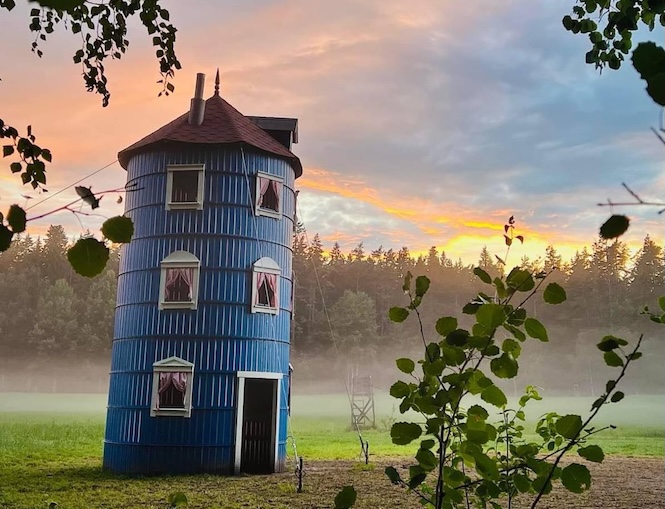
The Borderland, the Scandinavian Regional burn, now takes place in Alversjö, outside the town of Eksjö in southern Sweden. The land, consisting of open fields and undulating hills, cushioned by dense nature reserve forests on all sides, was purchased in 2022 after a multi-year community-driven fundraising effort.
“We were always dreaming of going from ‘leave no trace’ to ‘leave a good trace’. Now having this land ties us together and makes this possible. – Hampus Lindblad, Alversjö
The land hosts the annual event as well as smaller gatherings throughout the year where participants work on art, infrastructure, and shared projects such as gardens, sculpture parks and art symposiums. Hampus Lindblad, one of the founders, explains the motivation behind buying land, “We were always dreaming of going from ‘leave no trace’ to ‘leave a good trace’. Now having this land ties us together and makes this possible. We can go there throughout the year, build iteratively and both think and act within as well as beyond the scope of burns. This place is now truly ours and we intend to make the most of it. Not just for the benefit of ourselves but also for the existing local community.”
Hear Borderland community members Hampus Lindblad and Liselotte Norman share the Alversjö story on Burning Man LIVE:
AfrikaBurn followed a similar path in South Africa, securing a long-term lease on land in the arid Tankwa desert after years of hosting the event there.
In the United States, the Michigan Regional Burn Lakes of Fire recently reached the same milestone. When I spoke with Scott Vandevyver, one of the organizers, the purchase had only happened weeks earlier. “We actually closed on the property about thirteen days ago,” he excitedly told me. The community had been discussing the idea for nearly a decade before finally making it happen. The property spans 80 acres of woods, fields, and streams, along with a small house that might someday host workshops or gatherings.
For Scott, the significance of owning land goes beyond convenience. “Ownership gives you a seat at the table,” he explained. “You’re not dependent on someone else’s rules about what you can and can’t do.” And perhaps more importantly, it changes how people relate to the place. “At our previous venue we used to say ‘welcome home,’ but technically it was someone else’s property,” he said. “Now we can say ‘welcome home’ and actually mean it.”
Owning land changes the relationship between a community and the place where it gathers. Instead of appearing for a short period of time and disappearing again, people can return throughout the year, building infrastructure gradually and shaping the landscape over time.
Year-Round Communities Built Around the Principles

Not all of these experiments revolve around hosting events. Some Burners have taken the leap further, building permanent communities inspired by the culture they experienced through participation in Burning Man.
Just a few miles from the playa where Black Rock City rises each year, Fly Ranch has long been intertwined with Burning Man history. Black Rock City was held there in 1997 during a year when hosting it on federal land in the Black Rock Desert wasn’t an option. In 2016, Burning Man Project acquired Fly Ranch and began transforming it into a year-round cultural and ecological experiment.
Today Fly hosts a wide array of projects: regenerative practices, art installations, Burners Without Borders (BWB) gatherings, educational programs, and research initiatives. The land itself has become a fertile testing ground where Burners explore how creativity, regeneration, and community might intersect beyond the playa. “When people bring us their ideas [about what to do with the land] we say: how can we help you do that?” explains Matt Sundquist, Director of Fly Ranch.
Beyond the Nevada desert, similar experiments are unfolding in many other independent Burner communities. One example is Emerald Village Oasis (EVO), a small intentional community in the green hills above San Diego. The project began 15 years ago when a group of friends returned from Black Rock City with a shared question: what would life look like if the sense of community they experienced there didn’t disappear afterward?
There’s a common Burner joke that you shouldn’t “divorce your parakeet” and make life-changing decisions immediately after returning from the playa. This group ignored that advice completely. “We filled a blackboard with sticky notes,” one of the founders, Nick Heyming, told me when I visited EVO. “And the same themes kept showing up: land, space, community.” Within months they had found a property and moved in together.
Fifteen years later the project has grown into a small village. Residents live in individual homes but share weekly meals and care for the land together. There are gardens, gathering spaces, and workshops where people host events and creative projects.
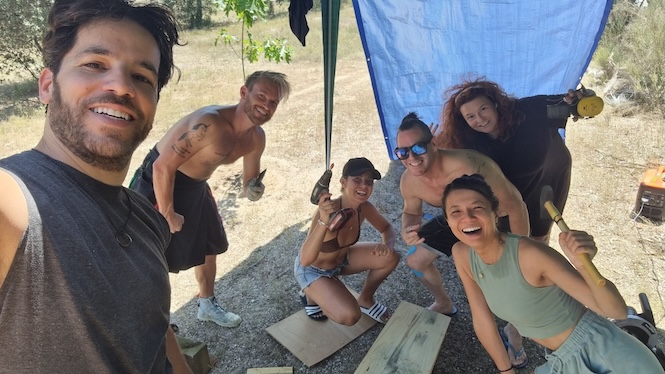
A newer experiment is unfolding in rural Portugal with Burn Village. Its main founder, Avner Had, first encountered Burning Man culture at Midburn in Israel in 2017. “I felt like I was discovering a new planet,” he told me. Years later, after organizing a small burn in Thailand during the COVID-19 pandemic, he began imagining what he calls a “slow burn” — a community where the principles could shape daily life rather than just a single event.
In 2024, Avner purchased rural land in Portugal and began building what is now called Burn Village. The early phase was simple: people living in trailers and tents, building cabins, installing electricity and internet. But gradually the infrastructure took shape. Now the project is ready for its next step, inviting residents and hosting small gatherings to grow the community.
At its core, the Burn Village is meant to explore the question: “Is it possible to create a society that lives with those principles while still being part of the modern world?” In his vision, the village functions much like a burn itself, with different “camps” focused on various interests such as permaculture, workshops, or creative projects. “The idea,” he said, “is to make the default world a bit more similar to that special week.” He hopes that, over time, a network of Burn Villages will emerge.
Avner began imagining what he calls a “slow burn” — a community where the principles could shape daily life rather than just a single event.
Other projects are being started in places where the stakes are higher. In Ukraine, Burners Without Borders grant recipient NGO 001 is developing a community of sustainable, off-grid homes. Its founder, Sergii Dumyk, found his inspiration in Black Rock City 2016, where he contributed his hardware skills to the Tesla Coils at Sextant camp. That experience led him to build House 001, the first in a village of fully autonomous homes that generate their own energy, water, and utilities. Today, NGO 001 is an official partner of the New European Bauhaus, a movement reimagining how we build for the future.
Where the Culture Goes Next
Looking across these projects — the newly purchased land of Lakes of Fire, the long-running experiment of EVO, and the emerging Burn Village in Portugal — a pattern begins to appear. Burning Man has always been a cultural laboratory. For decades that laboratory existed primarily in temporary environments. In these spaces, people experimented with new forms of community and creativity, within a limited timeframe. Land-based projects extend the creative cultural Burning Man experiment in a different direction.
Each project is unique, yet bound by the same ethos. Some revolve around events, others around daily life. But they share the same thread: to create a permanent expression of the learnings and participatory creativity sparked by participating in Burning Man. Spaces such as Black Rock City will always remain ephemeral. Each year the city will rise and disappear again in the desert. But the ideas that take shape there continue to resonate, shape lives, and serve as the basis for year-round projects that continue to evolve.
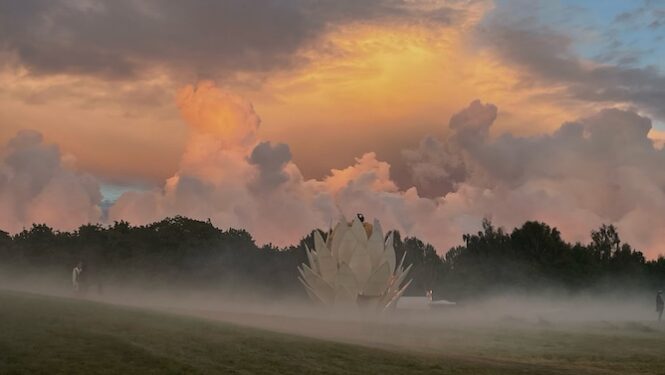
Cover photo: “Protea” Borderland 2024 effigy at Alversjö by Annie Locke Scherer (Photo by Cipriano Mauricio)

Wonderful stories about what is cooking around in the global community of Burning Man- Thanks
Report comment
Brilliant update and such a great expression of how an experience on the Playa of undeniable “community” is contagious !
Report comment
Thank you so much for writing that incredible article.
I would like to learn more about the different burn-communities that exist year round, like the ones you mentioned in the article (Fly Ranch, Emerald village oasis, Burn Village, …).
Is there a list of these places written somewhere ?
Thank you so much for your help.
Dusty hugs from South Africa.
Report comment
I’m not sure there is a comprehensive list right now, beyond this article. But that is a great idea, to create a map or network that gathers Burner land projects in one place.
Report comment
Comments are closed.