The AfterBurn is the Burning Man Project nonprofit’s annual look back at the past year in Black Rock City and the Burning Man global cultural movement. This yearly report, written by both Burning Man Project and community-run teams, highlights what the various departments do throughout the calendar year, and details accomplishments, learnings, and plans for the years ahead.
Browse past years’ AfterBurn reports here.
We also publish The Dispatch (f/k/a the Annual Report) each year about our overall vision, impact, and health as a nonprofit. Subscribe to the Jackrabbit Speaks newsletter to know when the 2025 Dispatch is live.
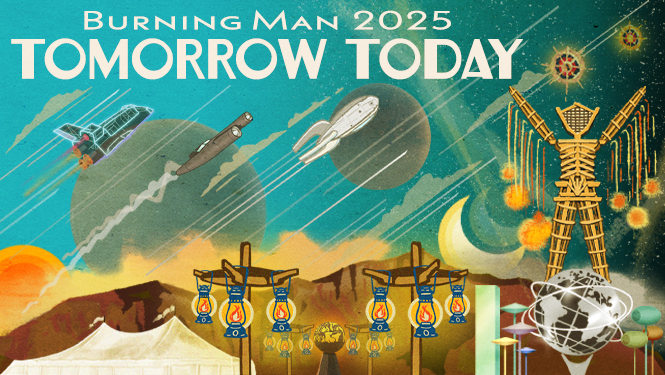
Burning Man 2025: Tomorrow Today
Tomorrow Today Around the World: Burning Man in 2025
Everywhere Burning Man touched down around the world in 2025, astonishing stories of connection and creativity flourished. From art parties to community workshops, multi-day campouts to resilience projects, people in this ever-inventive global cultural movement embodied the 10 Principles in endlessly inspired ways. The Black Rock playa and the world at large faced their share of challenges in 2025 — from desert winds and weather, to global turmoil and division.
When people come together to build, learn, and create they cultivate connections that have a lasting impact on the world; the Burning Man Project nonprofit exists to nurture these connective experiences.
Burning Man is a global cultural movement created by YOU, and nurtured by the Burning Man Project nonprofit. Year-round, Burning Man Project brings people together and stimulates creativity by producing the Burning Man event in Black Rock City. While around the world, the nonprofit provides tools, guidance, and inspiration to local communities that find a myriad of creative ways to bring Burning Man to life through art, gatherings, and community projects that help humanity and the world thrive.
Around the world in 2025, 110,000 people participated in Burning Man, through official and unofficial Regional Events, and projects that nurtured art and participatory creativity. The global community created more than 90 official Regional Events — from AfrikaBurn with 10,500 participants to Melting Man in North Dakota with fewer than 25. In the Bay Area, Decompression relocated to the Loom in Oakland. The Fly Ranch AfterBurn Campout, Fly’s first permitted event since 1997, brought together community members to reflect, rebuild, and regenerate. In Detroit, Brooklyn, and Black Rock City, Rising Sparks gathered people to explore what Burning Man could be for a new generation of changemakers. Burners Without Borders celebrated its 20th anniversary — two decades of grassroots action grown into 35 chapters across six continents.
Burning Man Project invests approximately $6 million in art every year. More than $5 million is invested in supporting art and artists in Black Rock City. Of this, $1.45 million is granted directly to artists through Honoraria; the rest covers the heavy equipment and logistical support required to install artwork on playa. The awe and wonder that Burning Man art inspires on playa now resonates everywhere. Out of 363 art projects in 2025, 58 came from outside the US representing 31 countries. Thomas Dambo brought his beloved troll “Rose Wonders” from Denmark. The 2025 Temple, “Temple of the Deep,” was led by Spanish architect Miguel Arraiz. For the first time, artists from Azerbaijan, Moldova, Nicaragua, and Peru brought art to the playa.
Every year, Black Rock City rises from the dust, ephemeral and wholly unique. There’s nothing else like it in the world. Inspired by the theme Tomorrow Today, Black Rock City 2025 served as the nexus and culmination of months of Communal Effort originating in communities from Tokyo to Kyiv, Akron to Calgary. Build a city we did. One that highlighted experimental creativity and whimsical innovation.
Beneath the 2025 Man Pavilion, “The World Fair of Unity” by Mark Rivera featured 15 artists who explored topics inspired by Tomorrow Today. Center Camp lit up around the clock with workshops, dance parties, performance art, and quiet conversations over tea.
Art that rose on the playa traveled far and wide. The 2024 Honoraria piece “Naga & the Captainess” by Cjay Roughgarden, Stephanie Shipman, and Jacquelyn Scott went on to frolic beneath a waterfall in Golden Gate Park. “BEAM,” the 2022 piece by Benjamin Langholz, now spans a lake in rural Portugal. Follow art journeys in “Art into the World,” a 2025 documentary by Profiles in Dust.
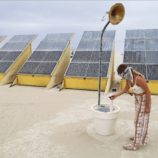
Throughout Black Rock City, staff and participants experimented with regenerative ways to power and illuminate their art, camps, and gifts. Built in collaboration with SOLARPUNKS, a new solar station powered two large camps and gifted charging to mutant vehicles and ebikes. Participant-run sustainability projects such as Burner Leadership Achieving Sustainable Theme Camps (BLAST) and Renewables for Artists team (RAT) mentored artists and theme camps, and the Green Corridor brought together 35 camps that offered regenerative knowledge and gifting sustainably-powered services.
Resilience was the word of the week. Rain came and high winds knocked out many camps and several art installations, calling on everyone to pull together and rebuild infrastructure tossed by the elements. Art crews embraced immediacy and turned catastrophe into new works of art. “Resilience” by Whitney Webb and James Smith re-salvaged their piece, originally built from Hurricane Helene remnants. “Black Cloud” by the Ukrainians ART Group was repurposed into the defiant phrase “NO FATE.” Artist Mona He reworked “MONA DIE! DIE! DIE!” into a contemplation of impermanence.
And, oh, the fire! “Haven” by Flaming Lotus Girls invited all to share a nest with magical, fiery avian friends. Across the playa, flame effects illuminated 110 mutant vehicles, 17 artworks, and 82 camp projects. Leading up to the release of the Man and Temple, participants gathered for 11 other art Burns, including “What Lies Beneath” by Reno Core Project and “As Above, Ao Cee Lo” by Zachary Caruso.
What began forty years ago as a bonfire among friends has blossomed into a global cultural movement that continues to grow and evolve, bringing in new humans, fresh ideas, and endlessly innovative ways to build a more creative, connected world. Whatever challenges we face, whether on playa or in the world at large, we face them together. Through acts of participatory creativity, we connect, experience awe, and create impactful ripples in the world. Burning Man, nurtured by the Burning Man Project nonprofit, is a staging ground that allows humanity to learn together, to iterate, and move forward with joy and creativity. We can only begin to imagine what is to come in the decades ahead, as a new generation begins to shape this global cultural movement to their hopes and dreams.
Table of Contents
For complete descriptions of the various Black Rock City teams, visit the volunteer teams page.
1. Art & Civic Activation
Burning Man Arts
Katie Hazard writes:
Resilience
The significant storms that blew through BRC this year caused quite a bit of damage to artworks that were still being built on playa. Yet in the aftermath, artists’ tenacity, ingenuity and creativity shone through, as they created new artworks from the wreckage.
- Whitney Webb and James Smith poured their hearts into “Resilience,” a powerful homage to the artists of Asheville, NC following the devastation of Hurricane Helene in September 2024. Ironically, “Resilience” — which was built from salvaged materials and housed a gallery of work damaged by or inspired by the hurricane — was ravaged by the initial storm at BRC. But the artists refused to be broken. They gathered the scattered pieces and rebuilt the artwork in a new form, proving that its name was a literal definition of their journey.
- The Ukrainians ART Group created the giant inflatable “Black Cloud” to symbolize the quiet, often-unacknowledged threats in life. It was a call for honest conversation, giving looming global and personal crises a physical form. Yet, in a twist of fate, the artwork itself was shredded by an unexpected wind storm. Refusing to be defeated, the artists repurposed the remnants of the black fabric and wove them into a powerful new banner which they erected proudly: “NO FATE.”
- Miao He conceived the artwork “MONA DIE! DIE! DIE!,” a wooden sculpture of dice symbolizing the friction between destiny and chance. Tragically, a wind storm severely damaged the structure mid-construction. Yet the team let the catastrophe become the art, posting a powerful reflection at the wreckage: “Polished outside, broken inside. Surrendered to chaos. Embraced impermanence. Rolled on Saturday. Will burn Friday sunset. Turning anxiety into art, pressure into play. Step into the unknown. Just roll with it.”
We were deeply moved by the outpouring of support and countless stories of people coming together in the wake of the storms, including volunteers and other artists supporting many other projects that were damaged by the storms.
Global Impact
2025 was an exceptional year for international art in Black Rock City, exemplified by the magnificent “Temple of the Deep.” Designed and led by artist Miguel Arraiz from Valencia, Spain, this marked a historic milestone: our third-ever international Temple and first from Spain.
We were also excited to host 58 artworks from 31 countries beyond the U.S.. Notably, four of these countries — Azerbaijan, Moldova, Nicaragua, and Peru — were represented in BRC for the very first time. And 22% of all art projects this year had international members on their build crew.
Some international highlights included:
- “Rose Wonders” – Thomas Dambo, a Danish artist famous for his giant trolls made from recycled and upcycled materials, originally intended to bring this sculpture to BRC in 2020, but was thwarted by COVID. We are thrilled that he was finally able to bring it this year!
- “Kauyumari Ceremonial Center” – This beautiful deer sculpture crafted by Leyla Brashka and her team of indigenous Wixárika craftspeople reflects their experience and rituals while in ceremony. It is now installed in a retreat center in Torreón, Coahuila, Mexico.
- “Point of Unity” – Mykola Kabluka, a first-time burner and artist from Ukraine was amazed by how Burning Man “cracks open the heart so we can truly connect.”
- “DROP” – This soft sculpture by Auli Uiboupin from Riisipere, Estonia depicts an oversized drop of mother’s breast milk. It was crafted collaboratively with individuals with special needs from rural Estonia, and woven entirely from textile waste.
- “Ad Astra” – Gabriel Sobin from Lacoste, France created this “modern Stonehenge:” six monumental sculptures, crafted from artificial stone and polished stainless steel, and arranged in a circle to form a sacred gathering space.
Increased Support for the Temple
Building the Temple in Black Rock City has become increasingly difficult for our community, due to rising costs and challenging fundraising. So we were thrilled to be able to find new ways to increase support for the Temple this year. These included:
- Increasing the Temple grant award amount from $150k to $300k (for 2025 only)
- Providing more support for the Temple Builders Guild (TBG), the nonprofit group of Temple builders who have assembled significant infrastructure for reuse by each new Temple, including a fully outfitted tool trailer, build/camp solar grid, camp kitchen, showers, and an impressive Leave No Trace (LNT) tool trailer. Additional support includes storage of their tool trailer at Black Rock Station and a $1,200 OFF grant to support TBG’s continued solar infrastructure development. Supporting TBG yields ongoing cost savings for each Temple and continuity of the brain trust that TBG represents.
A New, Improved Format for Desert Arts Preview
Crowd-favorite Desert Arts Preview — our annual sneak peek at Black Rock City art — underwent a successful transformation. By shifting from a live-stream to a pre-recorded format, we reached a wider audience than ever before, garnering nearly 15,000 views to date (as of Oct. 2025).
Increased Cohesion Among Art Department Volunteer Teams
We built a stronger, more unified Art Department volunteer team. To foster more cohesion among the subteams, we unified our recruitment and feedback processes and prioritized cross-training, allowing teams to collaborate more effectively. We also expanded our monthly pre-playa gathering, Art Scoop, to share BRC art highlights across all teams, and hosted a successful inter-team craft night, boosting camaraderie.
Improvements to Art Speaks
Art Speaks, Burning Man Project’s artist storytelling series, moved to be hosted at Burners Without Borders camp which was an excellent venue with ample capacity for participants, and a supportive atmosphere. Also, award-winning artists’ justice advocate and artist Sherry Wong moderated our exceptionally strong artist lineup, bringing a new perspective to the lively and engaging discussions.
ART AND SUSTAINABILITY
Sustainability efforts for art focused heavily on solar power this year. These energy savings were realized through several key improvements and collaborations:
Improved Energy Management for the Temple
The Temple team has consistently invested in energy independence, incorporating scarabs (mobile solar units) since 2022 and a Unicorn (a significantly larger solar power solution) each year since 2023, with several key improvements in 2025.
More Scarabs on BRC Art (Mobile Energy Units)
BMP’s Solar team expanded their support, initially providing mobile power solutions (scarabs) for nine art installations. Following the unexpected weather, they provided crucial additional support to three more installations that ran into unexpected power problems.
Expansion of “The Solar Library”
The art project “The Solar Library,” a series of secure solar charging lockers on the open playa, helps small art projects convert from generators to solar power by handling the supply, engineering, and transport of solar infrastructure. In 2025, thanks to funding from Burning Man Project, the project was able to serve 16 art projects, double the number from the prior year.
ART BY THE NUMBERS
- Third year of offering Q&A sessions in Fall 2024 for potential applicants to the 2025 art grant programs, attended by 177 people
- 363 total art projects in BRC
- 77 of these were selected as Honoraria artworks
- 58 international artworks
- 22% of projects had international crew members
- Artworks came from 32 countries (including the U.S.)
- Artworks came from 31 U.S. states
- 13 projects that burned (11, plus Man and Temple)
- 17 projects with flame effects
- 82 projects with flame effects in camps (inspected by FAST)
- 110 Mutant Vehicles with flame effects (inspected by FAST)
- 262 Art volunteers on the following teams:
- ARTerians, Art Support Services, Fire Art Safety Team, ARTery Ops, Eyes on Art, Quartermasters
- Art Discovery Engagement:
- 4,111 participants engaged via Mobility Tours, Bicycle Tours, Art Speaks, Self-Guided Tour and Audio Art Guide
- 5 tours were cancelled due to weather
- Hosted 11 Artist Tea Talks at BMHQ in SF, open to the community
- Art Dept staff had 1,000+ individual calls/zooms with artists to support their journey to BRC
- 2025 Desert Arts Preview: switched to a pre-recorded format for 2025, and have nearly 15,000 views as of October 2025
LEARN MORE
- YouTube:
- Burning Man LIVE podcast:
- San Francisco:
- Arts & culture:
- International:
- Local:
IN THE JOURNAL:

Burners Without Borders (BWB)
Tranquilitea (Heather Nuanes) writes:
In 2025, Burners Without Borders (BWB) celebrated its 20th anniversary — marking two decades of grassroots action. We honored this milestone through storytelling, film, and community celebration, including the “Give-a-Damn-a-Jam,” a 20th-anniversary gathering that united a worldwide community working on civic projects.
At BWB–BRC, offerings included the Mobile Resource Unit (MRU) container for on-playa tool sharing, the Skill-Building for the Resistance speaker series, a Civic Leaders Dinner for 150 partners, and a screen-printing studio blending art, gifting, and storytelling.
At the Oakland edition of Burning Man Decompression, BWB partnered with BWB San Francisco to extend Burning Man culture beyond Black Rock City. Together, we hosted a nonprofit mixer uniting local artists and civic groups, and presented BWB Ignite Talks on regenerative systems linking Fly Ranch and BRC. We also launched the BWB Activation Space Toolkit, a resource for replicating BWB-style participatory spaces at regional events. This collaboration introduced new audiences to Burning Man culture and reinforced BWB’s role as a cultural engine bridging art, service, and sustainability.
While our Black Rock City presence anchored the 20th Anniversary Celebration, our network’s global footprint continued to grow internationally:
The Lambano Coffee Project: Supported by BWB Sacramento Region, the Lambano Coffee Project in Bududa, Uganda empowers 500 local farmers through regenerative training and shared coffee-pulping machines that let them process and sell directly. In 2025, families completed their first self-processed harvest. With support from BWB Sacramento and the Auburn Gold Country Rotary Club, Lambano shows how grassroots collaboration and Burning Man values can spark sustainable, locally led transformation.
Burning Clean: Colombia Offsets the Dust, recognizing the environmental impact of international travel. BWB Colombia launched Burning Clean, an initiative to offset the carbon footprint of 50 community members traveling from Bogotá to Black Rock City. In partnership with Shambala, an eco-conscious collective, the project calculates flight and travel emissions and offsets them through tree planting in the Amazon. Beyond carbon capture, the team is activating community engagement across Bogotá through plogging events (jogging + litter cleanup) and the creation of huertas comunitarias (community gardens). Together, these efforts embody a holistic approach to regeneration—turning participation into tangible climate action at home and abroad.
EcoRoots: In collaboration with Burners Without Borders, EcoRoots launched a pilot permaculture training in San Mateo, Costa Rica. The two-week program equipped local agricultural workers with regenerative farming skills to boost income, improve food security, and protect the land. Participants built the first “Hub-o-Luv,” a community learning center for ongoing collaboration. Funded through community scholarships, the training model blends education, empowerment, and ecological action—showing how regenerative farming can uplift families while restoring the earth.
Ukraine Children’s Day Project: In collaboration with Rotary District 5190, BWB Sacramento, and Connected by Our Humanity, support was provided to Re4Win / Kyivwood, a small business in Kyiv whose workshop was damaged by a drone strike. With this aid, the team rebuilt and produced puzzle gifts for Ukrainian orphans and Children of Fallen Heroes, distributed on International Children’s Day. Two joyful gatherings in Zolotonosha and Smila brought comfort, creativity, and connection—reminding the children that even amid conflict, community and care endure.
Burners Without Borders Significant Accomplishments
- Expanded Civic Ignition Grant Program: We evolved our signature grant model to meet communities where they are — piloting two new versions.
- Civic Ignition Matching Grant Detroit: Honored BWB Detroit’s 18-year legacy and “Me to We” story while launching the BWB Backpack Toolkit to help new communities replicate their model.
- Regional Civic Ignition Grant: Designed to seed sustainable, creative projects at regional events worldwide.
BWB Chicago: Independently funded its own Civic Ignition Grant, proving the program’s scalability.- Burner Disaster Response (BDR): Awarded $2,300 for grassroots relief after Hurricane Helene, mobilizing Burners to clear debris, rebuild, and provide meals—living the mission of hands-on civic action.
Advancing Regenerative Culture at Fly Ranch
In 2025, Burners Without Borders deepened its long-term collaboration with Fly Ranch through two gatherings. The BWB Spring Summit: What Future Now? brought together 99 participants for four days of service, learning, and celebration, focusing on regenerative food systems, creative collaboration, and civic imagination. Using compost from the Black Rock Compost Program and biochar from the 2024 effigy burn, participants helped plant a thriving garden whose harvest later nourished Burners in Black Rock City, closing the loop between Fly Ranch and the playa.
Later in the year, BWB supported Fly Ranch’s first scaled, 299-person permitted event, helping demonstrate how Burning Man’s values can be prototyped through hands-on, community-led experimentation. The culture of BWB, rooted in service and collaboration, has become integral to the evolving work at Fly Ranch, shaping how projects are designed, how communities engage, and how regenerative systems take root for the long term. Looking ahead to 2026, Rising Sparks is expected to take on a larger role as we invite the next generation of Burners into the BWB and Fly Ranch story.
Expanding Support of the Green Theme Camp Community
BWB strengthened its partnership with the wider GTCC, providing logistical, financial, and strategic support to scale participant-led sustainability initiatives that help shape BRC. Programs like the Green Corridor, Burner Leadership Achieving Sustainable Theme Camps (BLAST), Renewables for Artists Team (RAT), and Black Rock Compost have continued to grow under this partnership, demonstrating how grassroots innovation, peer mentorship, and shared resources can accelerate climate-positive practices across camps and projects on- and off-playa.
Launch of the BRC Solar Donation Station: In collaboration with the BRC Solar team, BWB hosted the Solar Donation Station container at camp, providing free solar panels, components, and peer-to-peer education.
Sustainability Metrics with the Huella 0 Project: BWB began detailed tracking of waste, recycling, and camper CO₂ footprints through the Huella 0 Project to establish a measurable baseline for impact reduction.
Food Rescue & Redistribution Pilot: BWB diverted 700 pounds of surplus meals, transforming potential waste into nourishment for the community. This pilot demonstrated a creative model for food recovery and redistribution, aligning resource efficiency with Burning Man’s principle of gifting.
Regenerative Food Systems at Fly Ranch & Beyond: Summit participants constructed a Walipini underground greenhouse and a compost tumbler system, and also conducted a second-year Biochar Burn Ritual facilitated by Michelle Wong. The resulting biochar was used at Fly Ranch, in Altadena gardens, and at a permaculture program in Kenya’s Kakuma Refugee Camp.
LEARN MORE
- Projects:
- Events:
- Grants:
- Worldwide Calls:
Community Events
Justin Katz writes:
Community Events’ biggest impact this year was producing a spectacularly successful “Oakland Edition” of Decompression. For over 20 years Decompression has emerged and disappeared without a trace from the streets of San Francisco. This year brought about a bold play — to take a beloved community event across the SF Bay to The Loom in Oakland. We chose The Loom in part because it is a vital, active, art and maker space that has supported numerous playa-bound art projects (“Naga & The Captainess,” “Sonic Runway,” “Sphinx Gate,” “Moonlight Library”) and two Temple builds. We also were enamored with the opportunity to use a varied mix of indoor and outdoor spaces, with an intentional and differentiated design for each space to support distinct experiences for diverse audiences.
The event was a resounding success, with over 7,000 people attending throughout the day. We had a Salon featuring daytime programming, talks, and presentations. We had a Somatic Space with a tea lounge, sound baths, wellness workshops, and quiet conversational spaces. We had a Fire Art Garden that was a big hit with the Oakland Fire Department! BWB held an Oakland nonprofit mixer that brought together value-aligned organizations to meet, collaborate, and learn more about our mission and work in the world. We had over 200 performers across seven stages, 54 art projects installed over the week, and over 400 participants volunteering and providing content for interactive experiences. We left the neighborhood better than we found it, even leaving three large art pieces to be the start of a new art park container village for neighborhood cultural events.
The City of Oakland, Port of Oakland, the local Neighborhood Association, and local property owners all worked closely with Burning Man Project and The Loom to pull off the largest public event ever attempted in their neighborhood. Through sustained coordination, we got approval and permits to do our event, and in the end, the unanimous consensus was that we not only pulled it off, but left things far better than we found them.
March: We designed and produced a very successful Burnal Equinox in San Francisco, including a return of the legendary “Flambe Lounge” culture salon that blended live performances with updates and community conversations with Burning Man Project staff and leadership. We had the highest attendance since pre-pandemic times (1800 people!) and saw a record number of artists and performers squeeze into Public Works, an independent Burner-owned venue that supports many Burner-adjacent events throughout the year. It is very meaningful to the local community when staff show up, mix and mingle, and share, listen, and learn.
April: After an extensive nomination and vetting process, leadership from the Events and Regionals teams traveled to the UK and the Netherlands to land a final recommendation for the ELS 2026 host city. This involved extensive site visits and relationship building across the regional communities, which only serves to strengthen our organization’s relationship with and learnings from dedicated volunteers throughout the global network.
May: We supported the design and production of the BWB Spring Summit at Fly Ranch. For years the Events team has been a partner with BWB and Fly Ranch in creating diverse, impactful, and celebratory Summits on the shore of the Hualapai flat. As a production partner, we especially help with resource planning, site development, and inter-departmental communication. The Summits amplify our commitments to diversity, action, sustainability, and regenerative design.
October: We achieved a primary 2025 goal of the revitalization of Decompression, with a bold and ultimately very successful move from San Francisco to Oakland, CA. Over 7,000 participants turned out to co-create and experience an immersive day and night of both Burner and Oakland culture, mixed and mingled in an exciting and inviting site that gave many people their first taste of what it means to gather through the lens and values of Burning Man in an urban setting.
Burnal Equinox had a very challenging year in 2024, so we had to update and reinvigorate our format in 2025 to create a night that was financially viable for both Burning Man Project and Public Works, our venue. And it worked! We had record numbers not seen since the before-times, 2019.
At the AfterBurn Fly Ranch campout, wet weather caused an entire reorganization of the site plan. And it still worked really well!
COMMUNITY EVENTS BY THE NUMBERS
- $137,330 in net earned revenue between Burnal Equinox & Decompression, moving us towards an organizational goal of financial stability
- $12,000 in art and theme camp grants were given out between Burnal Equinox and Decompression to support community projects
- 434 volunteers were engaged in Bay Area community events in 2025
- 61 art projects installed between Burnal Equinox & Decompression, which is more than 15% of all art installed in Black Rock City in 2025
- 59 community members bought Supporter-level tickets to Community Events, which increase accessibility by offsetting lower-priced and ticket-aid tickets to our public events
- 2 Decompression billboards designed, printed, and installed by our team along Hwy 880 in Oakland, a Burning Man first!
Regional Network
Iris Yee writes:
In 2025 110,000 participated in Regional Events around the world. Spanning more than 100 locations, the Regional Network brings the Burning Man creative culture to life year-round through local events, grassroots civic projects, co-learning opportunities and more.
Strengthening Connection and Learning Across the Network
We hosted three Regional Contact Forums that brought leaders together to share experience, clarify roles, and explore healthy succession. We also launched Regional Events Forums for event producers to discuss challenges and exchange solutions. Recordings now live in a shared learning library. Our role was to help spark these connections, which continue through a growing culture of peer-to-peer support.
Planning the 2026 European Leadership Summit
Nijmegen, Netherlands, was confirmed as host city for the next European Leadership Summit under the theme The Art of Becoming. Planning began collaboratively with European organizers, shaping a participatory event where regional leaders, artists, and community builders can connect, learn and evolve together.
Resilience and Connection on the Airwaves
The Regional Network expanded its presence on BMIR Radio with two broadcasts: the new BRC Entry Show aired during a major dust storm, reaching Burners on playa and online with stories of international art and community. The Exodus Show closed the week with reflections about the week and ways to stay engaged through local art, service, and collaboration year-round.
SUCCESSES ACROSS THE REGIONAL NETWORK
Regional communities worldwide successfully turned the 10 Principles into local action through art, collaboration, and civic projects, a few of which are highlighted here:
- China: After a pandemic pause, the official Regional Event, Dragon Burn, returned, a joyful milestone of reconnection and renewal.
- Argentina: Volunteers from official Regional Event, Fuego Austral, hosted Lo que Fuego Nos Dejó (“What the Fire Left Us”) at La Sede, their community-run makerspace, celebrating what continues long after their annual event ends.
- United States – Arizona: Organizers of IGNiGHT fulfilled a long-term goal by bringing the official Regional Event beyond Phoenix to Willcox, introducing new audiences to Burning Man culture through interactive art, mutant vehicles, and all-ages participation.
- United States – California: Urban Dreams Art Experience transformed Sacramento’s Midtown into an open-air gallery of 16 participatory installations created with city and arts leaders.
- United States – Texas: The nonprofit, Catalyst Collective, which supports Burning Flipside, opened its community warehouse for the Austin Studio Tour, giving local artists free space and connecting the public with Burner creativity.
This year brought both challenges and growth. We adapted to limited resources, unpredictable conditions, and the balance between day-to-day operations and an ambitious Regional Network evolution project. Along the way, we shifted how we worked, leaned on collaboration, and focused on what delivered the most value.
Scaling Impact with a Lean Team
With three full-time and two part-time staff, plus a reduced budget, the Regional Network supported 230 RCs across 34 countries while also advancing multiple new Network Evolution projects and planning the 2026 European Leadership Summit. We used asynchronous tools and volunteer partners to stay connected, reviewing recurring efforts to identify what created the most value and pausing what didn’t or could wait.
Adapting on Playa to Weather Disruptions
Rain and dust storms in Black Rock City disrupted planned programming, but the team adjusted quickly, turning the conditions into moments of smaller, more meaningful connection.
Balancing Immediate Work with Long-term Evolution
We learned to balance day-to-day community support with the slower work of evolving the Regional Network. That meant pacing projects, adjusting timelines, and communicating clearly about what could realistically move forward.
Together, these adaptations reflect a year of focus, flexibility, and perspective. These qualities helped our team and the broader network stay resilient through change.
REGIONALS BY THE NUMBERS
Global Reach
- The Regional Network includes 230 volunteer Regional Contacts in 106 regions across 34 countries and one virtual space
- Regional Contacts are active in 36 U.S. states
Art and Culture Investment
- Official Regional Event art grants worldwide are expected to total over 1 million USD in 2025
Leadership Transitions
- 9 Regional Contacts retired in 2025
- 9 new Regional Contacts joined in existing regions
Official Regional Events
- 96 total events, the strongest recovery since the pandemic and approaching the 2019 peak of 108
- 92 in-person events: 58 in the U.S. (31 states), 34 outside the U.S. (17 countries), 4 online events held in Burn2, the long-established virtual regional space in Second Life
Participation Scale
- Largest event: AfrikaBurn (South Africa) with about 10,500 participants
- Largest U.S. Burn: unSCruz (California) with 3,200 participants
- Smallest event: Melting Man (North Dakota) with fewer than 25 participants
New Official Regional Events (2025)
- Leos & Lovers Bare Burn – Los Gatos, California
- IGNiGHT – Willcox, Arizona
- Witch’s Tit – Bruno, Minnesota
- Wicked Burn – Standish, Maine
- DC Burners Decompression – Washington, D.C.
- Ignition! TO – Toronto, Canada
- MPYRE Soul Stitch Decompression Weekend – Los Gatos, California
Mentorship and Capacity Building
- BRC Regional Event Lead Co-Learning Program included 14 leaders from 5 countries. Participants were paired with BRC staff from 13 departments. Leads were offered additional learning opportunities with 11 other BRC teams and access to year-round Hive training courses.
LEARN MORE
- Video
- Arts & Culture Media
- Radio
- From Burning Man to Saguaro Man – Principles in Action with Arizona Co-RC Armella Gaines (Queen Voney) and host Sam Dingman, KJZZ 91.5 Phoenix
- Short Film
- How Much Is Life – Ukrainian artist and community organizer Yaroslav Korets and the Kurenivka collective, documenting art and resilience during wartime
IN THE JOURNAL
2. Burning Man Project Staff & Year-round Operations
Administration and Facilities
Mel Hormel writes:
In San Francisco, Reno, and Gerlach, the Burning Man offices aren’t just a workplace; they’re a living, breathing cultural hub — a place where creativity, collaboration, and curiosity collide. Artists, donors, and community members gather here year-round to share ideas, celebrate art, and keep the Burning Man spirit alive.
Every year, the Burning Man offices staff challenge themselves to innovate new ideas, always with the intent of supporting our community and inspiring our staff members. This past year, we piloted a program that allows our community to use our office spaces for small events, classes, and workshops. Adding this to our offices has genuinely created a multi-use space. We now serve as a workplace, an event space, and an art space. The walls and halls of our offices tell our story, carrying the rich history in photographs, archival materials, sculptural art, and artist prototypes of the past. It is the bridge between our past and future imaginations.
Beyond our art and archival collections, what breathes life into our offices is the people. Our offices are where innovation meets action — a hub where teams collaborate across functions to push forward new approaches to sustainability, community engagement, and artistic empowerment. Through curated events like artist tea talks and staff appreciation events, we galvanize our team and community, fueling thoughtful discourse and cultivating community and staff dedication. We are committed to maintaining our organizational vitality, even for those geographically dispersed from our core operational hubs.
One of the most important aspects of Burning Man’s office operations is curating the staff experience. Maintaining a focus on staff wellness, sustainability, mindfulness, and creating enriching and inspiring places and events all contribute to ensuring that our staff understands their mental and physical well-being, as well as job satisfaction, are essential to us. Creating a community in our office that serves this purpose also helps increase staff retention, and in turn, leads to a more mindful and passionate staff when they are in service to our community. Our offices embody the culture we serve, and this is reflected in everything we do.
- Expanded the use of our offices by activating them for community use: Opening our doors to our community helps foster better relationships and strengthens community confidence in our usage of organizational resources.
- Enriched our community connection and visibility: By welcoming artists, donors, and volunteers into our spaces, we foster off-playa engagement, helping the community see how the work continues all year.
- Strengthened cross-office collaboration: Our offices in SF, Reno, and Gerlach operated in harmony, capping a three-year project to align our offices in operations and culture. Cross-office coordination makes our physical spaces a foundation for Burning Man’s broader mission.
- Elevated spaces for lofty ideas: By designing our workspaces thoughtfully and using those spaces creatively, we foster spontaneity, collaboration, and cohesion in our operations.
Staff Support, Connection, and Public Engagement
In response to budgeting challenges, many departments, including the offices, needed creative problem-solving to adjust to staffing shortfalls. By leaning on our colleagues, sharing resources and staff, and embracing flexibility, we were able to provide seamless service to our staff and community.
Budgetary reductions didn’t stop us from providing thoughtful gatherings for our staff and community. Funneling attendees into fewer engagements helped keep the fire burning without breaking our streamlined budget.
As we opened our doors to more community events, we learned to manage the logistics of sharing our space, including coordinating schedules, sharing equipment, and staffing, while maintaining flexibility and creativity.
ADMINISTRATION AND FACILITIES BY THE NUMBERS
- 3 Offices
- 3 Warehouses
- 4% increase in staff office attendance (from 2024)
- 18 Artist Tea Talks this year
- 6,271 thank you cards signed and sent
- 216 special events hosted for staff and volunteers in 2025
- 10 community usage agreements in the past year
Communications
Kirsten Weisenburger writes:
Burning Man Project’s Communications team is a multi-disciplinary crew of experienced Burners, veteran media storytellers, and press wranglers. We work year-round to advance powerful stories about the impact of Burning Man in the world, while protecting the culture from commercialization and exploitation. Under our umbrella are Burning Man Project’s social media channels, our blog the Burning Man Journal, Burning Man LIVE podcast, Documentation team, Speakers Bureau, Burningman.org (and its many, many subdomains), book publishing, and the culturally important work of the Philosophical Center, which serves as the conscience and collective memory of Burning Man. On playa we run and work out of Media Mecca, which also provides operational support to the BMIR radio station, Webcast, and Census.
A Rebuild and Redesign of the Burningman.org Website
2025 was dedicated to rebuilding and redesigning the Burningman.org flagship website. This was a major, multi-month undertaking that brought together members of the Communications and Tech teams to completely rework the information architecture and content of our legacy website, to make it contemporary and reflective of the nonprofit’s focus on supporting Burning Man in the world.
Merging Communications and the Philosophical Center
For several years Communications incubated a plan and vision to merge Burning Man Project’s Communications and Philosophical Center teams and projects. In 2025 the two departments officially merged into one team that oversees storytelling about Burning Man in all its various permutations — from Black Rock City media projects to book publishing, social media to Speakers Bureau, proactive press pitching and beyond. We function as a single Communications team that together develops content across multiple channels, while archiving the stories and voices that nurture the past, present and future of Burning Man.
Black Rock City Communications
In Black Rock City 2025, the Communications team supported hundreds of media projects with journalists, documentary producers, and photographers developing stories for media organizations and their own channels.
We connected in new ways with social media content creators, which included an on-playa content creator meetup at Media Mecca where Comms team staff shared guidance and got to know some of the emergent content creators who are developing stories in Black Rock City.
Working out of Media Mecca, Comms implemented year two of our content capture project in Black Rock City, which sends out small photographer-videographer-producer crews to interview subjects whose stories align with our year-round multichannel communications campaigns. Even the weather did not slow the teams down, who returned with a delightful repository of photo, audio and video content.
As part of our storyline development, we collaborated with the in-house Burning Man LIVE podcast and the Black Rock City Webcast to produce six live interviews that were broadcast live via the webcast, and recorded for later editing and distribution on the podcast.
Stories About the Impact of the Nonprofit
We rolled out monthly multichannel storylines that emphasize Burning Man’s enduring impact on the world — from technology to music, leadership lessons to Burning Man inspired businesses. Each storyline came to life across the Burning Man Journal, social media, Burning Man LIVE podcast, and the Jackrabbit Speaks newsletter.
Director of the Philosophical Center Stuart Mangrum crafted the 2026 Black Rock City theme, Axis Mundi, which calls upon Burners everywhere commune with the unseen and unknowable; a celestial column or center point, the Axis Mundi, often serves as a vehicle for traveling between worlds to access powers greater than ourselves.
The Communications team published the fifth edition of the Dispatch — a magazine style annual report that shares inspiring stories of the global impact of the nonprofit and cultural movement.
We continued our multi-year collaboration with OTHRS, a production crew developing a multi-episode documentary series about Burning Man Project that will be featured on HBO in 2026.
The Speakers Bureau supported Burning Man Project staff speaking at several conferences:
- Marian Goodell at Psychedelic Intersections at Harvard
- Stuart Mangrum at Giants of Design
- Various Speakers at Mid-Atlantic Regionals Conference
- Steven Raspa at Community Management Summit (CMX)
- Marian Goodell on the Sonia & Simon podcast
We incorporated more video and carousel-style storytelling into our social media posts, and leaned into sharing user-generated content that highlights the awe and impact of Burning Man culture and community. For the second year in a row, we posted social media content live from Black Rock City.
Our social media lead made a strategic decision to roll out relevant posts on our LinkedIn channel; content is being well-received and our follower count there is increasing steadily.
Managing Emergent Circumstances with Grace
During the stormy weather on playa, the Communications team wrangled media interest and supported messaging, working closely with government relations and event operations. Similarly, the team fielded media queries around a birth on playa, and following law enforcement’s investigation into a homicide at the event. Working out of Media Mecca, we supported several interviews with nonprofit leadership that were later published in notable international media outlets.
To illustrate the full breadth of Burning Man Project’s year-round work and Burning Man’s impact, the Communications team published a beautifully illustrated Impact Infographic. As part of a move to communicate with more transparency about the nonprofit’s finances, we collaborated with the new CFO to create a Summary Financial Information webpage, and integrated a Finances spread in the 2024 Dispatch.
Working closely with ticketing, we rolled out a communications strategy and campaign to announce a new Black Rock City 2025 tiered ticket price structure and cycle.
Throughout the year, we published four email announcements and accompanying Burning Man Journal posts to the community written by Burning Man Project CEO Marian Goodell. They provided updates about finances and ticket sales and expressed gratitude to the community. The emails culminated in “Why Burning Man still matters in today’s fractured world,” penned by Marian Goodell, and published in the Reno Gazette Journal.
In March and April, members of the Communications team helped develop and participated in the 2025 Community Forum, a series of in-person gatherings in Phoenix, Portland, Seattle, New York, Chicago, and Detroit. At each forum, Burning Man Project Staff listened, shared updates, and connected with core and curious community members. Forum staff participants then developed an analysis of learnings from the six gatherings.
COMMUNICATIONS BY THE NUMBERS
- 250,450 Jackrabbit Speaks newsletter subscribers
- 34 Jackrabbit issues sent
- 27 Burning Man Journal articles published
- 1.4 million Facebook followers
- 1.85 million Instagram followers
- 22.6 thousand TikTok followers
- 64.2 thousand YouTube subscribers
- 26 speaking opportunities managed
Burning Man LIVE Podcast
Our in-house podcast, Burning Man LIVE, celebrated its fifth birthday in summer 2025. At time of writing, the small but mighty team has produced 125 episodes with 287K downloads from 152K listeners, and 38K views on YouTube. Their episodes have been downloaded 47K times and viewed 14K times.
NOTEWORTHY PRESS FROM 2025
- Reno Gazette-Journal | Why Burning Man Still Matters in Today’s Fractured World
- Billboard | Burning Man’s Budget Shortfall: $14 Million Still Needed to Bridge the Gap Ahead of 2025
- DesignBoom | Miguel Arraiz’s Burning Man 2025 Temple is a Fragmented Geological Sanctuary for Healing
- SF Gate | I was wrong about Burning Man
- Bloomberg | Burning Man is Burning through Cash
- Wall Street Journal | Burning Man’s Online Now. Thank (or Blame) Starlink.
- Observer | What the Art World Can Learn From Burning Man
- Reno Gazette Journal | No matter out of place: Burning Man cleanup crew works to leave no trace
- Billboard | This Is the Official Burning Man 2026 Theme, And This Is How It Was Chosen
Documentation Team
Michael “Dustin” Fasman Writes:
The Documentation team achieved an unprecedented level of integration with the Communications team. Throughout the Black Rock City event, photos were transferred multiple times each day to the Social Media Manager, actively influencing the narrative in real time. The Doc team collaborated on more than a dozen assignments with Communications staff, including video interviews and other newsworthy stories.
The Doc team had photos in every issue of the Jackrabbit Speaks newsletter, many Burning Man Journal articles, the 2024 Dispatch, and other communications channels.
We provided documentation of several international Regional Events, as well as the Burning Man Decompression 2025: Oakland Edition.
The team’s Volunteer Coordinator secured the Fulcrum GPS enabled data collection software through the Art and Tech departments that gave Doc team members access to consistent and accurate data about installations and activities. Doc team images uploaded to the Burning Man Gallery will be more findable and informative.
We increased efficiencies getting photos and videos to the Communications team from the Black Rock City build, from Golden Spike to Build Week.
DOC TEAM BY THE NUMBERS
- 47 Doc team volunteers, including 6 first timers, from nine countries
- Over 4,000 photos from BRC uploaded to Widen, Burning Man Project’s digital asset management system
- 2 professional quality videos completed by the Profiles in Dust team
LEARN MORE
Education
The Education Team writes:
Our biggest story of the year was launching the Hive App, bringing Burning Man learning and connection to mobile devices worldwide. The app can be downloaded on iOS and Android. This expands Hive’s accessibility for Burners on the move, supporting global participation from Europe, South America, Australia, Africa and Asia. The app now functions as a year-round community learning hub, bridging on and off-playa culture with seamless mobile engagement.
Early feedback shows the app is helping Burners stay connected to projects, courses, and one another long after the event ends.
Playa Soul Repair – A Global Writing & Integration Workshop
In partnership with writer/educator Nick Powers (POC Camp), the Education team hosted a five-session global writing series exploring personal transformation and the emotional dimensions of Burning Man. Participants joined from multiple countries, sharing stories, processing Burn experiences, and connecting across cultures. The course integrated festival history, psychology, creative writing, community dialogue, and reflection.
Testimonials highlighted deep healing, personal insight, and renewed connection to Burning Man values.
2025 Camp Symposium: How to Still Love Your Campmates After the Burn
Produced and facilitated the Camp Symposium panel, “How to Still Love Your Campmates After the Burn,” focused on conflict mediation and emotional intelligence for camp leaders.
- Brought together cross-community experts (Ranger Keeper, Papadam, Big Soda, NoLimit) to share real-world strategies for navigating tension, repair, and group resilience in Black Rock City
- Equipped TCOs and camp leads with practical interpersonal tools to help their camps coexist and thrive during and after the event
- Advanced Burning Man Project’s mission by strengthening cultural fluency, emotional skills, and community connection across the global camp ecosystem
2025 Playa Storybook – Community Storytelling via the Hive App
We designed a storytelling campaign inviting Burners to share personal Playa memories. This strengthened global community bonds and provided early feedback loops on the Hive mobile app experience.
Psychedelic Harm Reduction Course (H.E.A.R.T Collective)
We collaborated with Zendo Project, DanceSafe, B.E.D., Fireside Project, and Journey Clinical to publish a free, foundational harm-reduction course. The course provides camp leaders and Burners everywhere with language, tools, and protocols to support safer psychedelic experiences on playa and beyond.
Harley K. Dubois Global Thought Leadership
Harley shared Burning Man’s insights on sustainability, leadership, urban design, and community-driven architecture through multiple podcasts and speaking engagements. These engagements extended Burning Man’s cultural model to architects, designers, planners, educators, and community builders around the world.
Other 2025 Projects:
- Released key new Hive courses including Psychedelic Harm Reduction, Burnout & Getting Stuck, Cultural Synergy, Paiute Insights, and Difficult Conversations
- Supported Event Ops Summit 2025: Created facilitator guides, aligned presenters, and strengthened session quality and engagement
- Advanced leadership development initiatives, including the Leadership Brown Bag Series and Succession Planning Course, setting the foundation for 2026 launches
- Shifted to multi-platform digital support (web + mobile), requiring revised workflows, testing cycles, and close collaboration with Technology
- Increased partnership with People Operations to support expanded safety, harassment-prevention, feedback, and manager training initiatives
- Scaled synchronous and asynchronous learning models, blending Zoom, Hive courses, and app-based engagement
- Adapted to evolving staff needs by supporting resilience training development following 2025 seasonal stressors
- Expanded content archiving and documentation to support long-term institutional knowledge and future curriculum builds
EDUCATION BY THE NUMBERS
- Burning Man Hive: 18,911 members worldwide, a 12.3% increase from 2024-2025
- Hive App Launch: iOS/Android/Desktop live; early engagement tracked across multiple countries
- 39 new courses added in 2025
- Courses w/ highest completion rates:
- 2025 PEERS Shift Lead Training and 2025 PEERS Training achieved 100% and 93-100% completion
- Sexual Harassment Prevention courses reached 95-100% completion
- 2025 Census Courses and Playa Info Lost & Found trainings: 78-91% completion
- Implicit Bias 101 and Introduction to Anti-Racism achieved 72-100% completion
- The R.I.D.E. series (Cultural Humility, Burner Fragility, Impact vs. Intent, Representation and Burning Man) consistently saw 51-63% completion
- Collaborative Decision Making, Conflict Resolution & De-escalation, Emotional Intelligence, and Difficult Conversations maintained 55-57% completion
- Playa Soul Repair: 5 sessions; strong attendance retention across entire series
- Psychedelic Harm Reduction Course: Thousands of impressions and widespread camp leader adoption
- Event Ops Summit: ~40 presenters supported through 1:1 coaching, guides, and prep sessions
- Harley Dubois thought-leadership media: 6,700+ impressions globally
- Internal training initiatives:
- OSHA-10 cohort fully enrolled
- Sexual harassment prevention training (1-hour & 2-hour tracks) on track for 100% completion by deadline
- Feedback in Action sessions were piloted with strong participation
- Learning Corner launch: all staff now have a centralized learning hub on Keyhole
LEARN MORE
- Download the Hive App on iOS and Android.
- Playa Soul Repair course
- Psychedelic Harm Reduction course
- 2025 Camp Symposium
- 2025 Playa Storybook
Finance
Juho Parkkinen writes:
Burning Man is one of the most significant cultural movements on the planet, and its non-commercial, gifting-based nature makes financial planning uniquely complex. Holding financial discipline and cultural integrity at the same time isn’t easy — but it’s essential. This year was about building the systems, partnerships, and shared understanding needed to do both.
Coming out of 2024, it was clear that some of the assumptions we had been operating under — about costs, ticketing, and how we explain money — no longer held. In 2025, Finance spent much of the year working closely with teams across the organization to change how money flows and how those choices are made visible, without losing sight of the culture that makes Burning Man what it is.
One of the most meaningful shifts was in ticketing. In close partnership with the Ticketing team, we helped design a tiered ticket model that made the true cost of attending Black Rock City explicit. This included a Pay-Your-Way ticket set at the per-person cost of the event, alongside Give-a-Gift ticket tiers that directly support Ticket Aid and lower-priced access, and a Receive-a-Gift ticket for those who need it.
What stood out wasn’t just the structure, but the response. Once the gifting logic was made obvious, the community self-selected. Making values visible changed how people moved through the sales process — not because they were pushed, but because they could clearly see how their choice fit into the larger whole.
At the same time, Finance worked closely with the Communications team and program leads to broaden how we talk about impact beyond Black Rock City. As Burning Man Project continues its transition into a global nonprofit — not just a single-event producer — we needed better ways to describe how platforms such as the Regional Network, Burners Without Borders, Fly Ranch, and other off-playa work bring the mission to life year-round. Finance’s role was helping translate complex financial realities into language that supported that larger story honestly and accurately.
- Ticketing model collaboration: Partnered closely with the Ticketing team to design a culturally aligned, inclusive ticket model that makes cost, gifting, and access explicit while walking the organization toward long-term sustainability.
- Cost governance as collaboration: Worked across departments to identify meaningful cost reductions while improving operations. Many teams leaned in creatively, finding ways to save money without compromising safety, experience, or mission delivery.
- Financial storytelling with Communications: Collaborated with the Communications team to develop clearer, more accurate ways of explaining how platforms beyond Black Rock City support the nonprofit’s mission. This work is helping shift the narrative from a single event to a global cultural movement with year-round impact.
- Structural clarity: platforms vs. program areas: Continued the shift away from treating Black Rock City as a “program area,” instead recognizing it as an operational platform that activates multiple nonprofit program areas. This clarified long-standing confusion and aligned financial reporting with how the mission actually operates.
- More timely financial insight: Introduced new tools and processes that improved the speed and usefulness of internal financial reporting, helping teams make decisions with more current information throughout the year.
Finance’s work in 2025 was shaped directly by lessons from 2024. Significant cost adjustments made last year carried forward and set a new baseline, allowing ticket-based revenue to better align with the real cost of Black Rock City.
We also adapted how we explain money. Under IRS rules, certain costs such as legal, people operations, accounting, and information technology must be classified as Management and Administration. In the past, this made Black Rock City appear artificially inexpensive. By shifting to a platform-based expense view, we’re now showing a more complete and honest estimate of what it actually costs to build and run Black Rock City.
In 2025, the focus was on designing systems where participants increasingly cover the true cost of Black Rock City, reducing reliance on opaque subsidies, and supporting year-round mission delivery across multiple platforms.
More broadly, Finance increasingly acted as a collaborator and translator — working with teams to ensure financial decisions were made through a cultural lens, and that the numbers told a story consistent with Burning Man’s non-commercial, gifting-based ethos.
- Introduced multiple ticket tiers that explicitly reflect cost, gifting, and access
- Engaged teams across the organization in cost-reduction and efficiency efforts
- Launched a public financial transparency website explaining expenses by platform and program area
- Shifted financial views to better reflect the full cost of Black Rock City as a platform
- Improved the timeliness and usefulness of internal financial reporting to support real-time decision-making
LEARN MORE
Fly Ranch
Zac Cirivello writes:
This year, Fly Ranch received an Outdoor Community Event permit for the 2025 Afterburn Campout — making it the first permitted event at Fly since Burning Man 1997. We invited groups including 2,210 Fly Stewards, Burning Man Regional Contacts, Burning Man Regional Event Producers, Burning Man Project Staff and Board, leads for 41 Burners Without Borders Chapters and 8 Projects, BRC Theme Camps, and Mutant Vehicles.
This year’s Fly Ranch Afterburn Campout marked a powerful moment for the Fly Ranch community that has been stewarding this land since 2016 to invite in the extended Burning Man community into the space that represents its long-term future. Taking place in October 2025, just weeks after the dust settled in Black Rock City, the gathering brought together artists, stewards, and collaborators from around the world to reflect, rebuild, and regenerate — both personally and collectively.
Participants from over a dozen countries, including Canada, Mexico, the UK, France, and Japan, joined longtime locals and first-time visitors for five days of connection, hot springs, art, and community.
As one participant reflected, “Fly Ranch feels like the heartbeat of Burning Man — it’s where the spirit of the playa continues to live and grow.”
The event featured community-led workshops and conversations as well as taking part in on-site stewardship and regenerative agriculture projects. Artists from BRC 25 brought installations, including “The Moonlight Library” and “Samsara Water Temple” to live long-term under the high-desert sky, creating venues for activation and continuing the living dialogue between art, nature, and human presence.
Participants brought their own micro theme camps and we even had our very first proper mutant vehicle, Coat Check!
The 2025 Afterburn Campout was a demonstration of how Burning Man’s principles can take root year-round while showcasing regenerative systems in action, from honey harvesting and solar infrastructure to zero-waste meals and local partnerships. Through gatherings like this, Fly Ranch continues to serve as Burning Man’s living year-round laboratory — a place where the global community can come together to imagine and enact a more sustainable, creative future.
Regulatory progress: Secured seven permits and passed five agency inspections, unlocking new possibilities for programming and strengthening long-term operational stability and partnerships with local and state agencies.
Honey and food production: Produced 600+ lbs of organic honey from 8 hives and 400+ lbs of vegetables, advancing regenerative food systems and land stewardship, and providing fresh, local food for campouts, local citizens, and the Black Rock City commissary kitchen.
Water infrastructure: Completed a new 115-foot well yielding 15 GPM, ensuring secure and sustainable water access for future restoration and programming.
Art integration: Installed two large-scale BRC artworks — “The Moonlight Library” and “Samsara Water Temple” — expanding Fly Ranch’s art presence and deepening the link between art, ecology, and community.
Rain: It rained a lot. It rained during the BWB Summit in May. It rained during Black Rock City. It rained during our Afterburn campout. During the Afterburn we activated the rain contingency plan laid out in our permit and moved all camping to the higher grasslands.
Following the budget challenges of 2024, the Fly Ranch team adjusted staffing and priorities in 2025, focusing capacity on scaling events and stewarding core operations. As a result, Stewardship Campouts were paused for the year. This shift highlighted both the strong commitment of Stewardship volunteers and the importance of rebuilding capacity for hands-on land care in the future.
FLY RANCH BY THE NUMBERS
- 60 – 250 weekly visitors for 32 weeks on volunteer-led projects supported by solar without generators since 2018
- 51 Nature Walks, weekly Labyrinth Walks, weekly Sunday Community Soaks
- 150+ Guardian Shifts, completed by 80+ active Guardians from nearby and around the world
- 2 Friends & Family Campouts open to 2K Fly Stewards
- New flyranch.org website with ~600 weekly flyranch.org visitors from 148 countries
- 8 beehives yielding >600 lbs of honey
- Produce grown and gifted at Fly events and to the NVO kitchen and BRC commissary
- 40 cubic yards of compost from BRC brought to Fly for garden
- 7 Permits and 4 inspections enabling expansion and revenue growth in 2026
- First permitted event since Burning Man 1997, opened to the wider Burning Man community
LEARN MORE
Government Affairs
Cailen Caplan, Marnee Benson and Katie Hoffman write:
Government Affairs achieved meaningful progress across multiple fronts, strengthening agency partnerships, reducing costs, and advancing long-term infrastructure goals.
Building on years of sustained efforts to manage BLM’s cost increases, the Government Affairs team successfully negotiated significant reductions to the agency’s 2025 operational costs.
Government Affairs convened two pre-event cooperator meetings focused on emergency planning and response. These meetings brought together federal, tribal, state and regional partners and improved coordination and preparedness for Black Rock City and the agencies supporting Burning Man.
Government Affairs played an instrumental role during the massive dust storm Saturday before the Gate opened and in the following days of rain. Our team coordinated with the BLM, Pershing County, Washoe County, Pyramid Lake, and the State of Nevada, along with Communications and Event Operations, to ensure rapid response to emergent weather conditions. We supported public communications and traffic management, as well as the Unified Command system we use in Black Rock City. Fine-tuning our protocols leading up to the event helped tremendously to create a faster response to challenging conditions. This work continues!
Government Affairs also demonstrated radical adaptability amid shifting conditions and uncertainty for our federal partners, including multiple key staffing changes, resource limitations, and varying levels of availability within BLM and the Department of the Interior.
Government Affairs worked with Event Operations to implement and understand complex regulatory requirements and their impact on Black Rock City. Examples:
- Working with the Fuel department to satisfy new equipment standards set by the Nevada Department of Agriculture
- Securing State of Nevada approval to integrate EMS Utility Terrain Vehicles into emergency medical response
- Amending the BLM closure order to allow limited night flights from the airport
- Assisting Outside Services to meet BLM inspection requirements for delivered housing
- Collaborating with GPE and public safety partners to incorporate the new Wadsworth Bypass into traffic control plans
- Guiding authorized drone pilots through the Temporary Flight Restriction exemption process
After a multi-year effort involving Government Affairs and Legal, Burning Man Project acquired 6,500 acres of federal geothermal leases near Gerlach, protecting the area from utility scale power development. The acquisition of these leases will advance Burning Man Project’s goals to invest in Northern Nevada and showcase innovative, sustainable technologies and systems in rural areas, potentially benefitting other communities across the west.
Government Affairs worked diligently to support efforts at other Burning Man Project properties in Nevada to maintain compliance with health regulations and improve infrastructure reliability. At Fly Ranch, Government Affairs helped secure a federal Right-of-Way permit for the access road and gate renovations, obtain a County permit for the first permitted special event at Fly Ranch since 1997, obtain permitting for a new freshwater domestic well, and obtain a producer’s certificate authorizing the sale and distribution of honey and produce from Fly Ranch’s regenerative systems.
LEARN MORE
Innovate Program / Innovate Developer Community
Andrew Lowe writes:
The Innovate Program sparks innovation through open data. Since 2014 we have provided the Burning Man Public API to camps, art installations, and developers.
A strong example of the Innovate Program’s global impact is the Dust app.
Dust is an open source offline event app developed by a member of the Innovate Developer Community. It started as an event guide for Black Rock City. Dust’s developer drew inspiration from our open data, API-driven approach, mirroring the types of datasets we provide for BRC as a framework for Regional Events. It has now expanded to support 45 Regional Events across 20 US states and five countries.
Dust and apps similar to it are developed by the community serve to decommodify technology at Burning Man events. In the absence of commercial event apps, the community builds their own. Many participants choose to leave their phones behind, but for those who don’t, the Innovate Developer Community has gifted them offline ways to engage that are for participants, by participants.
The Tech Department worked closely with Communications and Placement to make more participants aware of apps through the Placement newsletter and social media. We made call outs for developers to help with open source Innovate apps. This led to new connections between developers and further engagement with the community.
This API saw a huge refresh in 2025 with API V2. This new platform fixed long-running bugs, improved data quality, and made it easier to add new datasets in the future. More than 60 development teams moved to this new API in 2025, representing the most active members of the Innovate Developer Community. Using this new platform, we added camp images to the dataset, allowing for a more visual representation in camp listing and community applications. We plan to add more data in the future.
In May we hosted our second annual Fireside Chat attended by 17 developers and staff. This event was an opportunity for the Innovate Developer Community to meet face to face with year-round staff. We heard about all the unique projects for 2025 — everything from event guides to physical hardware. We also had a discussion with the Placement team about their workflow, data release schedules, and what we can do to better support innovators.
The Innovate Program depends heavily on mapping data that is geolocated based on where the city should be pre-playa. In the past, the survey of the city didn’t always match the mapping data we provide to developers and use internally. In 2025, the Innovate Program lead and other members of the Tech team went out to the playa pre-survey to flag 40 geolocated points for reference. This allowed for our mapping data to be more accurate and ready to share sooner. We also worked with the survey team to figure out how to integrate this step into their process for 2026.
With the rising popularity of community apps, a large portion of events (around ⅓) are submitted to Playa Events after the deadline for inclusion in the print WhatWhereWhen guide. The apps offer an alternative way to discover events. While people do love the paper guide, community apps allow a sustainable expansion of interactivity without needing to rely on the limited resources of a printed book.
INNOVATE BY THE NUMBERS
- 15 showcased community apps
- 64 approved APIV2 Keys
- 148 Members of Innovators Discussion List
Top Apps
- iBurn: Peak of 37K active users on the first day of the event.
- Dust: 27.9K opened Dust during August to Labor Day
LEARN MORE
Legal
Adam Belsky writes:
Revamping Intellectual Property and Decommodification Guidelines
In 2025 our team was a leader of a major initiative to create clear, comprehensive guidelines on the use of Burning Man intellectual property and event imagery. Collaborating closely with the Event Operations, Placement, Communications, and Art departments, we are in the process of developing guidance that balances the preservation of Burning Man’s Decommodification principle with the realities of new technologies. These guidelines are a milestone for the organization — they provide a unified framework for all teams and community members, helping prevent misuse, clarify expectations, and protect the integrity of Burning Man into the future. Once finalized, the guidelines will be shared with the community and incorporated into the new Burning Man website, making them accessible and ensuring consistent understanding and application.
International Trademark Protection and Enforcement to Preserve Decommodification
Internationally, we continue to work with European, South American, and Asian counsel to oppose “Burning Man” trademark applications by companies seeking to use Burning Man’s fame for commercial purposes, and to expand our own international trademark portfolio to protect against this. We entered into a settlement agreement with a French company that had applied to register “Burning Man” trademarks for jewelry and perfume, in which the company agreed to withdraw its trademark applications and change its labeling and marketing. We successfully opposed trademark applications in Turkey and Portugal for “Burning Man” marks and currently are challenging trademark applications for “Burning Man” in Brazil and Argentina. We have filed trademark applications to increase our scope of protection in a number of countries.
On June 2, 2025, BLM approved the transfer of the six federal geothermal leases from Ormat to Burning Man Project that were the subject of our lawsuit challenging BLM’s approval of Ormat’s proposed power plant project in Gerlach, Nevada. Pursuant to the terms of our Settlement Agreement with Ormat, we then dismissed our lawsuit, and Ormat dismissed its objection to our transfer of water rights to Burning Man Project’s 360 property. We are exploring a number of exciting opportunities to use our newly acquired geothermal resource as part of our development of the 360 for community use, including heating and cooling for buildings, recreational use, and potentially low-cost electricity generation to meet the power needs for the property.
The Legal team collaborated with the Regionals team to revise and update Regional Event Agreements and Regional Event Criteria to better reflect current community practices and organizational priorities. We established a shared understanding of how Legal can best support Regionals, including guidance on trademark use. We developed processes for evaluating unauthorized third-party use of Burning Man trademarks and supporting international Regionals with trademark registration and protection. This strengthens the global Regional Network by providing clearer expectations, consistent support, and culturally aligned protection of Burning Man’s identity and values.
The Legal team worked with the Art Department to revise the Art Honoraria and Temple agreements to better support artists and protect Burning Man Project. We clarified key terms related to artist insurance, liability, breach/cure processes, sale of artwork and proceeds, public safety, and driving regulations. This ensures artists have clearer guidance and stronger support while maintaining shared responsibility for safety and cultural stewardship. This aligns contractual frameworks with current practices and reduces risk for both artists and the nonprofit, supporting a thriving, expressive art ecosystem in Black Rock City.
In 2025 our team adapted to the departure of the Associate General Counsel, which required us to adjust our workflows and redistribute responsibilities across our team. Each team member stepped up to take on additional duties, and we leaned into a more collaborative approach to ensure continuity of support across all areas of our work. While this transition initially presented challenges in managing workload and maintaining institutional knowledge, it ultimately strengthened our communication, trust, and collective problem-solving as a team.
LEGAL BY THE NUMBERS
- 200+ contracts reviewed, drafted, or negotiated (including art agreements, vendor/service provider agreements, independent consultant agreements, media agreements, book license agreements, speaker agreements, and high-value commercial agreements with medical services provider, air charter provider, and ticketing provider)
- 25+ educational outreaches and demand letters sent as part of Legal’s IP protection and enforcement program to address intellectual property misuse and media policy violations
- 5+ public and internal policies reviewed and updated (including cross-department IP guidelines project, Legal’s IP protection and enforcement program, terms of service for APIs and datasets, data privacy policy, and staff training guides)
- 5+ new agreements drafted to support new Burning Man initiatives (including the Rising Sparks Grant Program, Sustainability Grant Program under the OFF Initiative, community office use agreements, BRC virtual reality agreement, and others)
- 10+ internal departments supported and collaborated with (Art, Placement, Comms, Regionals, Tech, Government Affairs, NVO, Accounting, PO, PE, event operations, Fly Ranch, Education)
LEARN MORE
Nevada Operations and Gerlach, Nevada
Theresa Soos writes:
The biggest and most impactful story for Nevada Operations (NVO) this year was bringing the Man Pavilion home: for the first time, both the Man and the Man Pavilion were built entirely in Gerlach, marking a significant operational and cultural shift.
This project moved away from the previous system of using rented facilities in distant locations like Reno or Northern California and consolidating the build at Burning Man’s year-round home. The move was a practical and visionary decision, designed to streamline logistics, reduce costs, and enhance communication between teams.
By building in Gerlach, the team had direct access to NVO’s full ecosystem, including materials inventory, tools, fabrication facilities, housing, and safety support. Purchasing and receiving were already established in Gerlach, allowing materials to arrive directly at the job site. The team could also draw from existing surplus inventory, reducing downtime and duplicate purchases.
This operational unification was a success, proving that NVO can innovate and facilitate complex projects from within its own desert home.
The Saloon demonstrated Burning Man’s values in action by donating six pallets of supplies, including non-perishables, clothing, bedding, and camping gear to the Paiute community living on Pyramid Lake.
The 360 Crew overhauled its participant container (PC) transport operations by implementing an improved tracking and staging system. This new process enhanced team efficiency and resulted in a 30% reduction in the 360 Crew’s total operational time compared to the 2024 season.
NVO successfully recycled more than 26,000 pounds of cardboard gathered from Burning Man Project’s operations and the town of Gerlach.
The containerized batteries and solar structure were functional for the entire year, providing sustainable power solutions for NVO’s long term operations.
NEVADA OPERATIONS BY THE NUMBERS
- 2,100+ Work orders completed by Ranch Operations and Gerlach Waste Streams in 2025
- 2,000+ Auto Shop work orders created from January to November, with a 96% completion rate
- 3,900+ Maintenance repairs, service requests, and emergency calls completed by Mobile Maintenance on the BMT and PUA fleet in 2025
- 2,500 Mobile Maintenance repairs captured in the MaintainX (MX) system
- 590+ Maintenance calls handled from June to September, with a 97% completion rate
People Operations
Karen Jacobs (KJ) writes:
This year, People Operations deepened cross-department collaboration by working more directly with the Rangers and Emergency Services Department. This included new slack channels and increased in-person coordination, improved response times, and strengthened alignment between teams.
Expanded on-site support services in Gerlach and Black Rock City — provided consistent in person support for people from May through November.
We created new training tools, including templates built into the Escalation Process, giving managers consistent guidance and language for addressing performance, conduct, and team dynamics.
We partnered with the Education team to develop and release a new Safety Training course in Burning Man Hive, focused on proactive, people-centered practices. The course covers hazard identification, emergency response, PPE use, environmental stressors, and OSHA standards, reinforcing a shared culture of safety across all worksites.
Conducted a deep clean-up and reorganization of department folders pre-season. These updates streamlined internal and external processes, resulting in noticeable improvements on-site including higher rates of timely and complete documentation submissions.
Evolving team structure and shared learning: Internal shifts prompted deeper cross-training and collaboration within People Ops. Team members expanded their understanding of overlapping functions, supported one another through transition, and strengthened continuity across the department.
In-person collaboration and reflection: Increased in-person work sessions with Education and Volunteerism strengthened connection and alignment. For the first time, the teams held a pre-season gathering in the spring and closed the year with an in-person post-season debrief, creating new opportunities for shared planning, relationship-building, and reflection.
Although historically all recruiting activities have paused for the months that we are on playa, we needed to work to fill the significant role of BRC Deputy Chief of EMS and couldn’t put the search on pause. Therefore we organized on-playa interviews which involved coordinating with people on playa and finding an appropriate interview room inside the people pod.
The People & Learning team reimagined and rebuilt existing hiring systems and processes. These new innovations aim to connect major departments through smarter tools and automation, making hiring faster, more accurate, and far less stressful for everyone involved. Alongside that, new dashboards and trackers gave teams better visibility and flexibility, helping them stay focused on supporting people instead of troubleshooting spreadsheets.
We worked through a major change in our team, as two team leaders and two seasoned team members moved on from Burning Man Project. We welcomed new leadership who have both industry and Burning Man expertise, and will continue to build out the team in 2026.
PEOPLE OPS BY THE NUMBERS
Seasonal Hiring:
- Number of hiring requests processed in 2025 = 2,073
- Decreased by 14% (from 2,387 in 2024)
- Number of seasonal employees hired in 2025 = 1,020
- Decreased by 3.1% (from 1,053 in 2024)
- Number of seasonal roles filled in 2025 = 1,486 (many employees choose to work more than one role during the season)
- Increased by 2% (from 1,455 in 2024)
Rising Sparks
Taylor Andrews (aka Tay) writes:
Rising Sparks began as 30 friends under 30 attending Black Rock City in 2024 and evolved into a formalized initiative serving 220+ active members and 890+ event attendees in 2025. Through our ticket allocation, we helped more than 90 individuals access Black Rock City (63% first-timers) — more than tripling our 2024 impact, achieving 50%+ under-33 engagement.
As one participant shared: “Rising Sparks is an open invitation for the next generation to shape what Burning Man can be.” Another reflected: “Joining Rising Sparks makes Burning Man seem less of this unattainable thing and more of a judgment-free welcoming community experience.”
Kick-Off Gathering (February 7, 2025) – officially launched Rising Sparks in San Francisco — where it all started — at Burning Man Project headquarters with 245+ attendees generating 100+ connection form submissions. By hosting at headquarters, we symbolically positioned next-generation voices at the heart of Burning Man’s future, featuring trivia, a Rising Sparks DJ, and organic intergenerational mingling that broke down traditional barriers. As participants told us: “Gen Z needs Burning Man!” and “I want to be part of the younger generation that helps others understand the magic and possibilities of Burning Man… The Burn is a place I hold so dearly to my heart and I have the full hopes of carrying on all of the principles and original meaning of the festival into future generations.”
Brooklyn Center for Theatre Research Partnership (April 19, 2025) – bridged Burning Man with NYC’s creative communities through the launch of Spark Cast. This brunch gathering featured CEO Marian Goodell, NYC-based artists, theme camp leads, and young Burning Man creatives in conversation about how principles influence artistic practice. Drawing 75+ attendees into intimate dialogue, this partnership demonstrated how Rising Sparks creates pathways for curious newcomers to become active contributors while reaching diverse creative communities beyond traditional networks.
Burner Meetup at Psychedelic Science (June 18, 2025) – Rising Sparks hosted a Burner Meetup at Mockingbird in Denver, bringing together Burning Man community members and curious newcomers for connection and cross-pollination between transformational communities. The gathering featured a VR preview of the 2025 Temple of the Deep by Temple Build Leads, and created grounding space for intergenerational connection during the conference.
Costume & Clothing Swap (July 22, 2025) – Hosted at Burning Man Project headquarters, 120+ attendees gathered to swap clothing, costumes, and accessories, embodying Decommodification and reuse culture. The event extended garment lifecycles, reduced waste from new purchases, and created community connection through the gifting economy. All leftover items were donated.
Rising Sparks Open-Camp in Black Rock City (August 2025) — 30 Rising Sparks open-camped together, 19 first-timers. As one reflected: “I learned more about Burning Man in those few hours rebuilding shade than in all my pre-playa research.” This experience directly informed our 2026 planning — we’re now developing comprehensive first-timer preparation resources and mentor-pairing systems.
Center Camp Next-Gen Burner Mixer (August 27, 2025) – After igniting communities in SF, Brooklyn, Boston, LA, and Denver, Rising Sparks brought the momentum to the playa with a Next-Gen Burner Mixer at Center Camp. The gathering welcomed all next-generation participants to meet the entire Rising Sparks crew and Spark Council, and connect with their people.
Detroit Art Rising x Decompression (October 4, 2025) – launched our Intergenerational Mentorship Grant program, designed to support next-generation creative collectives and Burning Man-adjacent communities through partnerships with established leaders across art, innovation, sustainability, and cultural preservation. This pilot brought together emerging Detroit collectives (Make Art Work, Art Night Detroit) with seasoned Michigan community leaders (Detroit Michigan Burners, Syncytium — a Detroit-based Black Rock City theme camp) to co-produce a free, 10 Principles-based event through structured mentorship. The collaboration created a platform where local Detroit artists, innovators, and creative communities experienced Burning Man culture authentically, engaging 255+ attendees (63% first-timers). The event featured live art performances, interactive installations across three stages, and flame effects, all while maintaining complete Decommodification (zero vendor sales). This $10,000 investment proved modest funding plus mentorship catalyzes profound impact. One Detroit attendee captured the impact: “I was really inspired by the mission to cultivate a community of young artists and creatives. Chatting with active participants throughout the event gave me both the confidence and excitement to pursue my own creative path.”
Established Spark Council Governance – Established a 20-person Spark Council with open-sourced, collaborative leadership model stewarding Rising Sparks’ growth across Denver, Bay Area, LA, and NYC.
Burners Without Borders (BWB) and Fly Ranch Collaborations – Rising Sparks deepened partnerships with Burners Without Borders and Fly Ranch throughout 2025. Council members collaborated with BwB at East Bay Decompression, while 10+ Rising Sparks members participated in direct land stewardship at Fly Ranch, contributing to the garden during Family & Friends Afterburn. For Detroit Art Rising, we partnered with BWB on comprehensive venue restoration before and after the event, ensuring Leaving No Trace principles. Remaining funds from Detroit Art Rising supported BWB Detroit, which received matching funds from Burners Without Borders, demonstrating continued partnership beyond the initial event.
CHALLENGES & ADAPTATIONS
Balancing Grassroots Authenticity with Organizational Formalization – Maintained free events and peer-to-peer communication style while building professional backend systems. Emphasized that Rising Sparks isn’t taking over but learning through two-sided mentorship and intergenerational collaboration to evolve together.
Learning to Build Containers for the 10 Principles Beyond Black Rock City – Detroit Art Rising served as our learning laboratory — maintaining zero vendor sales, grant funding rather than sponsorships, mentorship-guided cultural translation for urban environments.
Navigating Social Media as a Tool for Community Storytelling – Developed an approach that amplifies authentic voices and lets the community share their stories around the world. Balancing visibility with authenticity while utilizing it as a platform to bring existing communities together and engage the curious in a way that shows the embodiment of culture.
RISING SPARKS BY THE NUMBERS
- 890+ total event participants across seven gatherings
- 220+ active community members
- 63% first-time Black Rock City participants in ticket allocation
- 50%+ under-33 engagement (vs. 12% Black Rock City overall)
- 90+ ticket allocation recipients (vs. 30 in 2024)
- $10,000 Intergenerational Mentorship Grant deployed
- $40,000+ additional funding secured
- 6 Cities Ignited: SF, NYC, Denver, Detroit, LA
LEARN MORE
Technology / IT
Steven Blumenfeld writes:
As the dust from the 2025 event settled and our systems were successfully debriefed, the Technology Group presents this AfterBurn report. This past year was monumental, defined by a necessary pivot toward deep architectural modernization, security compliance, and a renewed focus on nurturing the innovative spirit of our extended technical community.
The technology supporting Black Rock City and the year-round Burning Man Project is a fundamental contradiction: it is highly customized and sophisticated, yet must survive some of the most challenging environmental conditions on Earth. Our success lies not in glamorous applications but in the foundational stability we provide, which ensures our global mission can thrive. In 2025, we consciously moved beyond maintaining the status quo, initiating major, multi-year programs to cement a digital foundation for the next decade.
STORIES: STRATEGIC DIRECTION AND INNOVATION
The core narrative of 2025 was the shift toward proactive, risk-averse development and the cultivation of a community that views technology as a form of volunteerism.
Website as an Operational Ecosystem – We didn’t just redesign a site; we reinvented an operational tool. By delivering custom templates and patterns, we’ve created a resilient self service public face that elevates our connection with the public while modernizing our internal content creation ecosystem. This was not merely a cosmetic update; it was a restructuring of how the organization communicates its values to the world.
The Prototyping Revolution – We have formalized a “fail fast, learn faster” directive to enhance prototyping capabilities. This shift is crucial for fostering continuous innovation and ensuring data informed decisions. It allows us to quickly test novel concept, related to community engagement and new forms of digital expression. This environment acts as a “playa for ideas,” where technical risk is isolated from the mission-critical backbone. To hep support this, we implemented Tech Team Skill Share sessions. We are working to institutionalize time for creative non-work projects, acknowledging that the spirit of invention that builds Black Rock City must also power our organizational technology.
Radical Tech Inclusion – The Innovate community is a strategic source of “community gifts” in the form of engineering and software. Through fireside chats and the “Future of Innovators” series, we’re exploring the philosophical edge where tech volunteerism meets the playa, discussing topics like AI-created art and how the principles of Burning Man prepare us for an increasingly automated technological future.
SUCCESSES: SYSTEM DELIVERY AND OPERATIONAL MASTERY
The 2025 cycle was defined by the delivery of critical new projects and the robust management of legacy.
Stability and Uptime – We achieved 99.95% availability for core platforms during the critical 60-day event cycle. This performance, maintained despite a city-wide power outage and a physical fiber cut, validates our investments in infrastructure health. This stability allowed critical functions to operate without impediment during the most stressful periods of the year.
The BRC Dashboard Project – Highlights the power of community-led development. This real time visualization tool, developed by the BMIR team, dramatically improved situational awareness on and off playa. We have now institutionalized this project by moving it into a full production deployment, utilizing professional development pipelines. This ensures the BRC Dashboard is not just a one off experiment but a sustainable, auditable tool for future events.
Legacy Exit and Transition – Despite the inherent deficiencies of aging platforms, our infrastructure team ensured continuity by deploying the Marcato software one final time. Simultaneously, planning for a new Event Asset Management System. This transition is vital; it marks our move away from outdated, highly customized solutions toward a more agile, modern framework for 2026 and beyond.
CHANGES: DATA SECURITY, COMPLIANCE, AND ARCHITECTURE
The most significant strategic shift in 2025 was elevating data security from a “tech task” to an “organizational pillar.”
The Data Governance and Privacy Initiative – We launched a complex, organization-wide project to establish a comprehensive Enterprise Data Map. This is essential for proactive regulatory compliance (such as GDPR and CCPA) and ensures we meet our commitment to ethical stewardship. By mapping these flows, we can minimize data retention and protect the privacy of our citizens with technical precision rather than just policy intentions.
Architectural Modernization and Resilience – We are launching an Integrated Delivery and Resilience Initiative to enhance our security posture. Our customized platforms can be vulnerable to code errors; this initiative enforces a secure, auditable development pipeline. By implementing automated code deployment and rigorous testing environments, we reduce the risk of human error or unauthorized changes introducing vulnerabilities into our ecosystem. This professionalization of our workflow ensures that growth does not come at the cost of security.
Policy Overhaul – We are clarifying and updating organizational policies regarding digital resources. This ensures our digital channels, from internal Slack instances to public facing forums, remain focused on the core mission and adhere to tighter governance standards.
TECHNOLOGY BY THE NUMBERS
The 2025 event confirmed that we can achieve greater operational efficiency through strategic hardware upgrades and intelligent network design.
Data Volume – Our Wide Area Network (WAN) processed 112 Terabytes of data moving in and out of Black Rock City. This staggering volume underscores the digital weight of BRC logistics, from high-resolution imagery to real time telemetry.
Throughput and Capacity – We maintained a total backhaul capacity of 2.5 Gbps, with peak mission critical throughput reaching 550 Mbps. This capacity was strictly prioritized to ensure that staff operations and public safety communications remained uninterrupted.
Network Efficiency – The network supported 6,000 simultaneous unique users and over 8,000 registered devices. Notably, we achieved better coverage and higher speeds using only 171 Access Points (APs), a significant reduction from previous years. This confirms that our move to newer, more efficient hardware is paying dividends in both performance and power consumption.
CONTINUITY: THE CULTURAL ROADMAP
The Cultural and Operations Roadmap Project is the centerpiece of our multi-year strategy to ensure Burning Man Project’s continuity across generational changes. Technology is only as good as the culture that maintains it.
Generational Stewardship – We are working to transcend technical documentation by transforming decades of accumulated history into an actionable “cultural lens.” By codifying the principles of “what we do and why,” we provide future stewards with a solid foundation for decision making. This allows the next generation of leadership to innovate while remaining grounded in the core principles of Burning Man.
Operational Resilience – This pillar focuses on building scalable systems that reduce organizational friction. We are standardizing data flows (such as GIS and participant identity) to make event execution repeatable and less reliant on tribal knowledge. By shifting from reactive annual cycles to a predictable, year round operational flow, we reduce overhead and prevent the burnout that often plagues high-intensity technical teams.
CONCLUSION
The 2025 cycle was about stabilizing the present while strategically building the future. We have placed data security, architectural modernization, and the nurturing of the Innovate community at the center of our map. The work completed this year serves as the bedrock for the next generation of technology, ensuring we continue to amplify creative expression and protect the community in a digital world that is constantly shifting.
3. Black Rock City (BRC) 2025 Operations
Airport
Simon Hill (aka Trash Dad) writes:
In 2025 a group of glider pilots successfully completed the first ever glider operations out of 88NV. They launched the glider with an electric vehicle that was charged off a solar array, which makes this the first fossil-fuel-free flight. They intend to come back in 2026 with a winch system and a second glider to expand operations to offer glider scenic flights to participants.
We created the Flight Operations Advisory Council, which is a group of experience aviators and experts from our community that come together to discuss flight operation policies, procedures, and other aviation nuances throughout the year. This taps into the enormous knowledge base that exists in our community, while also creating a pathway for community input into our operations.
Josh Bergman, a scenic gifting pilot, successfully set the record for most scenic flights gifted in a single day during the informally named “Scenic Surge.” He flew a total of 44 gift flights in one day.
The daily weather events during the beginning of Black Rock City required constant adaptation for the Airport team. It was necessary to close the airport during the whiteouts and rain impacts, diverting inbound BxA flights.
We created a new minimum staffing system that allowed us to dismiss most volunteers ahead of the weather events if we expected to fully or partially close the airport. This allowed volunteers to make the long trek back to their camps so they didn’t get stranded at the Airport during the dust or rain impacts.
We developed an additional layer to our weather response plan in which we created a team to go out during and after the storm to systematically identify and attend to any issues caused by the weather. This included assessing and mitigating damaged structures, finding lost and trapped humans and bringing them to shelter, creating transportation plans for stranded staff and volunteers, checking on our volunteer camping areas and the local theme camps, and other tasks.
BRC AIRPORT BY THE NUMBERS
- 2,630 flight operations (half landings, half takeoffs)
- 2,953 BxA passengers transported
- 992 total scenic passengers (these are the folks that are gifted a flight around BRC)
- 200+ volunteers
American Sign Language (ASL) in BRC
Thomas Duran writes:
The Deaf Community comes from all over the world to participate in Black Rock City. This year our team was able to interact with and provide service to a number of different Deaf attendees.
In 2025, we:
- Successfully implemented a new system for how our team provides services to Deaf Burners on playa
- Did outreach to inform other departments of our existence at in Black Rock City
- Created a living document to serve as a handbook for future volunteers with our team
- Coordinated as a camp to reduce the footprint of resources brought to Black Rock City through more shared space/resources
The weather in 2025 impacted infrastructure that we were counting on early in the week. We came together to adapt our plan to make sure everyone on our team had the resources and protection they needed to focus on and succeed in their role. We had new leadership take over the team and it was a learning experience on delegating.
ASL IN BRC BY THE NUMBERS
- 0 Unfilled requests
- 35 Filled requests
- 8 After-hours / Emergency requests filled
Arctica
Christina Pearson writes:
We had a great year! While we are excited to have several successes/challenges this year to report on.
We had several wins:
- Implemented a new inventory tracking system.
- We had several people move into new leadership roles this year. We really feel like we have the right people in the right place for right now.
- This year we reduced our sales hours, which allowed us to operate the igloos with fewer total shifts. As we are seeing a consistent decrease in volunteerism this was fantastic. We also were able to keep up the energy in the igloos for volunteers and reduce boring downtime. Condensing our hours helped keep the experience fun and lively for volunteers without causing any meaningfully longer lines.
Every weather event brings a slightly different puzzle for Arctica to solve. Are the roads dry enough to haul ice to the igloos? Will they be tomorrow? If we get them staged at the igloos early will we be able to fuel them? Will the incoming heat increase demand for ice? Our team was able to roll with the punches and our hours of operation were minimally impacted by the rains early in the event.
From 2022-2025 Arctica has had three Ice Queens (operations managers) who have reported to three different up-the-chain managers. We have had the opportunity to look at how we do things with fresh perspective.
In response to changing volunteer participation, the Arctica team streamlined operations this year by adjusting shift structure to better match available capacity. These changes helped ensure consistent coverage, and the vast majority of igloo shifts were successfully filled throughout the event, allowing Arctica to continue serving the community reliably.
ARTICA BY THE NUMBERS
- 1,129 available shifts on shift board
- 129 unfilled shifts on shift board
- 829 individual volunteers
- $55,177.27 in tip donations
Black Rock City Event Operations
Charlie Dolman writes:
The 2025 event, while presenting unique challenges, was a powerful testament to the community’s spirit and the professional execution of the teams. The event began on a high note, welcoming participants to a beautiful, sunny, and calm playa, and generally managed initial operational challenges with efficiency and grace.
We successfully navigated significant weather events, high winds and four consecutive days of rain, which tested both organizational and participant infrastructure. Our dedicated teams demonstrated immense effort and resilience. Notably, the Gate team, bearing the brunt of the weather’s impact, worked tirelessly to manage travel times that were significantly longer than expected (due to the repeated road closures) while maintaining safety and professionalism under extreme conditions.
The rapid onset of these weather events, with short notification windows, highlighted an opportunity to improve our warning and response protocols. In a proactive and agile response, we successfully developed and implemented the HSERP (High-Speed Emergency Response Plan). This new process and protocol, which we practiced effectively multiple times, is now being adopted as a Standard Operating Procedure (SOP) for Black Rock City, significantly improving our preparedness for rapid weather changes and unexpected off-playa traffic management issues.
We were deeply saddened by the tragic loss of a participant, Vadim Kruglov, during the Man Burn. Teams across the organization provided critical, professional support to the Pershing County Sheriff’s investigation, demonstrating our deep commitment to the community. As of writing this report Burning Man Project continues to support efforts in this matter, including a contribution to a nonprofit fund that supports crime-solving.
Financial stewardship remained strong, with many teams successfully managing zero budget growth and in many cases coming in under budget — a significant achievement given continually rising costs. Overall, the Event Operations department attributes the successes of the event, financial and otherwise, to the dedication of its team leads and their respective departments.
LOOKING AHEAD TO 2026
We will be reviewing all the emergency responses and their relation to on and off-playa traffic management as part of the 2026 event preparation.
BMIR
Jex writes:
BMIR and the BRC Dashboard’s role is to be of service to the citizens of Black Rock City (BRC) — to disseminate factual information in a timely manner so that all who participate are well-informed and safe given any and all circumstances. Once the event ends, we too, disappear into the dust.
This year, our team worked nonstop to make sure the citizens of BRC were well-informed throughout the multiple weather and emergency events causing delays and disruption to our city. We expanded our storytelling team, allowing for a more diverse set of stories to be aired throughout the event.
BRC Dashboard
The dashboard team improved the BRC Dashboard to better handle message flow and site scalability. This allowed for clear, concise, and reliable communication to the citizens of BRC, the general public, and government officials throughout emergency and weather events as well ingress, egress, and the moments in-between.
BMIR did our best to inspire the citizens of BRC to unapologetically express their beautiful selves with kindness, compassion, consent, Radical Inclusion, equality, equity, and personal autonomy—and of course, to cause wondrous mischief, cast magic, and induce playful chaos. Perhaps our temporary existence is an indirect facilitation to remember how magical and beautiful this life is.
This year, BMIR led the effort on a new radio tower, upgraded to 80’, that joined BMIR together on a single tower with Playa Info, Weather, and Webcast, with fantastic support from IT. As a solidified interdepartmental team, we worked exceptionally well together through all of the trials and tribulations that come with such a massive technological undertaking. We saw great success with our new collaboration, a tower with a greater reach, a new home for Webcast, and a stronger connection with Playa Info.
We took additional steps this year to retain our established tented shade setup. This decision helped keep our team and equipment dry and protected during weather events, enabling us to remain operational and continue serving Black Rock City.
Burner Express Bus (BxB)
Simon Hill (aka Trash Dad) writes:
The particularly unpredictable and impactful weather of 2025 took place during the peak hours of Burner Express Bus operations. The dust storms and rain events always impact the flow of buses onto and off of playa dramatically. After several years of weather events, the Burner Express Bus team has become incredibly adept at preparing and modifying contingency plans based on the ever changing conditions. This year the Burner Express Bus (BxB) team performed their work with exceptional agility, flexibility, and creativity. This was made possible by the relationship building and collaboration with key players from many other departments, including ticketing, GP&E, and Burning Man Project leadership. This flexibility and excellence ensured that all BxB passengers arrived and departed as scheduled.
The BxB team extended bus service to include Friday of Build Week. This creates access to transportation for theme camp build crews, as well as volunteers that need to arrive early.
The BxB team had a very high ratio of returning staff, which made for a very smooth year in terms of operations. Additionally, staff morale, enthusiasm, and unity was higher than ever. The vibes were good all the way around. This trickled down into an excellent participant experience as the staff brought the energy to keep it fun.
Despite the weather impacts, all buses made it onto and off of playa as scheduled.
During the rain event that closed Gate Road, there were several buses that were stuck on the pavement with no route into the city. The bus drivers are legally required to operate within a limited number of driver hours, so ensuring that they can efficiently move through BRC is imperative. To resolve this, a combined crew of BxB and GPE staff managed to create an impromptu route that crossed from the 8 mile entrance to Point 1, effectively avoiding the areas that were too wet to traverse.
Two buses became stuck in the mud on their way into the city. A team of BxB trucks and drivers were able to drive out to the stuck buses to manually unload and shuttle the passengers and their luggage into BRC. The reduction in weight then made it possible to free the buses and get them off playa just before conditions became completely impassible.
Relationship building, excellent communication, and close collaboration with GPE made it possible to prioritize moving BxB buses off playa through Pt 1 without requiring them to stop. This proactive coordination protected vehicles and schedules during challenging conditions, preserved critical partnerships with bus providers, and helped maintain the overall capacity and reliability of the BxB program.
BxB BY THE NUMBERS
- Passenger Ingress: 7,058
- Passenger Egress: 6,285
- Total BxB Passengers: 13,693
- Total Bus Count: 246
Census
Random writes:
The BRC Census is a volunteer-driven collaborative research project that gathers data to serve the needs of Burning Man Project, academics, and Black Rock citizens. Our mission is to collect, analyze, and report data that accurately represents the true makeup of the BRC population in a safe and ethical manner. Our vision is to establish the Census as the most trusted and reliable primary source of information about the population of BRC.
In 2025, the BRC Census team collaborated closely with Burning Man Project CEO and Communications team leadership to revamp the Census survey. After 10 years of intentionally asking the same questions to create trend reports that showcase the evolution of responses from BRC citizens over time, we took this opportunity to revisit each of the questions in the survey and re-evaluated which ones to keep, which ones to modify, and which ones to discontinue. A virtual Census Summit was held on 2/6/2025 to kick off this effort and align on timelines and next steps, followed by a deliberation meeting on April 22, and several rounds of reviews before the new and improved 2025 Census random sample form and online survey were finalized. The streamlined 2025 online survey focused on questions considered essential to the Burning Man Project and was 50% shorter than the 2024 version to improve response rates and limit survey fatigue.
The BRC Census team also disseminated a Playbook to Regional leads interested in starting their own Regional Census. “We found great value in the Playbook developed by the Census team guiding Regionals like us on how to start and implement our own Census surveys, including examples of questions to pick and choose from”, said one of the Regional leads. “It was great observing first hand how the Census is run at the San Diego Regional, YouTopia,” shared the BRC Census manager. The Census team also collaborated with Oakland Decompression leadership to support data collection at the event on October 18.
In the spirit of the Tomorrow Today theme, we leveraged QR codes in innovative and fun ways to expand on our outreach efforts promoting the Census online survey. We added a QR code to our Census stickers with a link to our primary webpage (requires internet connectivity) and another QR code with a calendar reminder to complete the online Census after the Burn (works offline). We incorporated the offline QR code in printed Census street signs that we added to every radial along C-street and also had it on our 4 posters at the Census Lab, our support camp Counter Culture, and along the fallopian tubes during Exodus.
Like many other departments, we had to adapt to the inclement weather on playa this year. With volunteer safety in mind, we had to cancel a total of seven data collection shifts (five Gate Road shifts and two Airport shifts), which led to a smaller random sample being collected. Our amazing statisticians put their minds together to come up with the proper methods to leverage this smaller dataset for adjusting the online Census results.
Running multiple surveys in parallel with the online Census highlighted the importance of clear coordination and sequencing to support ease of participation and strong response rates. While some participants completed the new BRC 2025 Post-Event Survey thinking they had finished the Census, this experience underscored an opportunity for closer collaboration and consolidation of survey efforts with Census in 2026 and beyond to maximize participation, sample size, and data reliability.
CENSUS BY THE NUMBERS
- Celebrated having 181 amazing Census volunteers who supported our operations in 2025
- Received 5,021 complete responses and 1,534 partial responses to our 2025 online Census survey
- Collected 1,332 Census random samples plus another 450 samples (paper forms) from self-selecting BRC citizens
- Completed 5 data collection shifts on Gate Road plus 4 shifts at Airport, and randomly sampled 10 Burner Express Buses
- Had 136 participant entries in our Census Field Notebook journals
- Planned 3 Data Bash events (lecture series) at the Census Lab on playa
- Served 26 gallons of pink lemonade to volunteers and visitors
- Collaborated with 3 new academics interested in collecting data for their respective research topics through Census
LEARN MORE
- Census on Burningman.org (including past Census reports)
- 2025 Census preliminary results in the media
- Census online report
- Census HIVE community page
- Contact us: census@burningman.org
Center Camp
Laura Day writes:
The biggest, most impactful story from the Center Camp Canopy team this year was the successful realization of the Canopy as a truly thriving civic incubator and gathering space — the “mirror of Black Rock City’s creative vitality.”
The Incubator Effect (Civic Ethic in Action): The team’s focus on platforming offerings from within BRC and lowering barriers to entry created a vibrant ecosystem where small planned and spontaneous acts of expression flourished. This year, the space hosted nearly 200 unique planned activities (and many spontaneous ones) by more than 200 groups involving at least 500 humans. The inclusion of 10 Civic Support Camps, newly integrated in collaboration with Placement, demonstrated a successful model. These groups were able to “bring their thing” to the Canopy’s infrastructure (such as art shows, workshops, or performances) without the full commitment of a theme camp, allowing new participants to practice Gifting and Radical Self-expression. As one collaborator noted, they were grateful for “an avenue to share their gifts with the city without the need for the required interactivity of a theme camp.” This model successfully cultivates community by providing a supportive entry point for new creators.
Complex Production and Amplification: The stage showcased some of the most complex and professional productions to date under the Canopy, thanks to the up-leveled lighting and stage design (including the modular stage from the Relequarium team from Rhode Island). This high-quality platform enabled performers to refine and showcase their work, reflecting the city’s growth in artistic excellence. There is ample room to improve the quality of the stage’s sound to support the community’s expanded offerings.
Weather & Resilience: Last year, the Canopy leadership team created a weather event response plan in accordance with five levels of weather severity. Plans include internal team response comms, managing new volunteer tasks, fencing plans, AV/power safety, etc. In 2025, the Canopy remained closed for two days at the top of event week due to rain, following an assessment of the unsafe nature of the Canopy’s flooring and stage equipment. Event-week volunteers were deployed to squeegee the floor and mop up muddy playa, guardians were called in to support the closed perimeter, crew care managed a driving ban amidst fluffing services, and the production team rotated a 24/7 lead to monitor the lighting and power.
The production team spearheaded a structural knowledge exchange with at least one Regional Event. The team’s success in supporting diverse programming and infrastructure is being consciously positioned as a model of how civic spaces can carry culture forward. The Canopy also functions as a place to play and experiment with the yearly themes for the BRC event. The future goal to partner with at least one Regional burn to co-develop a stage or gallery activation in 2027 shows a clear path for extending this impact beyond the US.
- Platforming: The Canopy’s new vision was fully realized, hosting nearly 200 planned activities and integrating over 200 groups and 500 humans. This lowered the barrier to entry, facilitating more participation and extending the principle of Radical Self-expression to a wider, often newer, audience without the need for a full theme camp.
- Cultivating Community/Recognition: For the first time, a pathway was created to include Center Camp artists in the official Burning Man artists listing webpage. This ensures that the diverse expressions inside the Canopy (13 installations, 22 muralists, 54 gallery pieces) receive appropriate recognition and visibility, strengthening the art community year-round.
- Extending Participation: In collaboration with Placement, 10 civic support camps were integrated into the neighborhood. This new model provides infrastructure for groups to share their gifts at the Canopy while living in the neighborhood, successfully bridging a gap between individual participants and larger theme camps.
- Support & Sustainability: The team internally released a Collaborator Toolkit and piloted onboarding videos for volunteers and collaborators. This improves logistics and operational clarity, honoring the year-round work of volunteers and creating a more sustainable framework for future growth.
The team was ready due to an updated 2024 Weather Plan. The opening was delayed until Tuesday at noon due to the tarp floor turning into a “slip & slide.” The team quickly redirected artists, rescheduled programming, squeegeed the floor, and mopped thick playa mud to ensure the space was safe and welcoming.
The team addressed this by diversifying offerings by our internal creative team SWIFT, testing more intentional scheduling with the addition of Circus Coordinators, and introducing cross-collaboration with the gallery curation process. This shift professionalized the programming while maintaining plurality.
A formal feedback process for Collaborators was started in 2024, and expanded in 2025. This allows the internal team to receive notes and requests directly, leading to measurable upgrades and adjustments to communications and on-site build integration.
CENTER CAMP BY THE NUMBERS
- Unique Scheduled Offerings: Nearly 200
- Collaborating Groups (Theme Camps, Individuals, Artists): More than 200
- Participants Impacted (Programming Groups): At least 500 humans
- Volunteer Count (9 Teams): 174
- Civic Support Camps Integrated: 10 (in collaboration with Placement)
- Art Installations Under Canopy: 13
- Muralists: 22
- Gallery Art Pieces (in collaboration with Branches Gallery): 54
- Placed Plaza Art: 8 pieces
- Total Shaded Area: Nearly 1 acre
- Interactivity/Shenanigans Offerings: 64 (the highest single category)
IN THE JOURNAL:
Community Services
Terry Schoop writes:
In 2024 we had set the stage for team leadership transitions with ‘What if?’ departure scenario exercises and discussions at our on-playa department meeting. We also hosted a succession training presentation presented by Burning Man Project, and Community Services founder and Chief Cultural Officer (CCO) Harley K. Dubois. This year, we saw an unprecedented leadership transition among five of the nine Community Services teams: the Department of Mutant Vehicles, Lamplighters, Playa Info, Temple Guardians & Volunteer Resource Team.
Between 2024 and 2025 we proposed, and it was agreed, that Arctica ice sales move from Community Services oversight to DPW Business Services, for a better operational fit. The Canopy in Center Camp Plaza remains a Community Services team with management oversight by the Associate Director of Operations and ongoing support from the Community Services Administrative Coordinator.
With budgets tight, we transitioned the subsidized Tow/Emergency Road Service operations from Burning Man Project to participant-funded, saving Community Services and Gate, Perimeter and Exodus thousands of dollars. For service requests, we shifted from communications hardware to an online form, which provided an egalitarian first-come, first-served queue. This allowed us to continue working with a valued, longtime vendor. Late in the game, our longtime locksmith vendor was forced to withdraw, and even with great effort, we were unable to secure a replacement.
Driving permit stickers across all departments are branded DMV, with fulfillment managed by Community Services Management. We found significant savings simply by switching sticker stock from reflective to standard for pre/post driving permit stickers.
Department of Mutant Vehicles (DMV)
Hilary Somers writes:
In 2025, we said goodbye to three council members, and added four new members. Existing council members helped ease the learning curve for the new members. The weather made 2025 a good year to learn about how the DMV and Burning Man adapt and succeed. Adversity brought us together as a team on playa. We were able to keep the DMV operating as long as possible, between storms, and during planned closed hours, by coordinating with key crew members in their camps. All the council members, from the newest to the oldest, gave all they could to support the success of the DMV, and it worked.
The DMV began tracking mutant vehicles across years by giving each a unique identifier. This helps the DMV track how vehicles evolve and improve across time, and it helps MV owners by reducing data entry for returning vehicles.
The DMV build and art crews built and decorated a new “Gas Station” building at the start of the vehicle queues. Its multicolor lighting and art-deco styling were only topped by a new lit DMV sign.
The weather closures were made more difficult by a schedule change we made this year: reducing our open hours from Wednesday to Friday, which are usually our slow days. Without a way to notify volunteers of these last-minute changes, it caused a lot of confusion. Fortunately, our dedicated volunteers checked in and showed up without any prompting. And two DMV support camps, The Pit and The OG Pit, had a critical mass of volunteers to keep the DMV open.
With a change in art presentation at DMV, there were a large number of wall art pieces no longer being used. They were gifted to the crew at our on-playa training, almost all artwork was taken to new homes.
DMV BY THE NUMBERS
- We invited 760 Mutant Vehicles, but only licensed 535
- The no-show rate was 27%, which is higher than the average of 23%
- We licensed 302 of the 499 invited Accessibility Vehicles
- We believe the high no-show rate for both types of vehicles was due to the weather
LEARN MORE
Department of Public Works (DPW)
ChAos writes:
Black Rock City’s (BRC) Department of Public Works (DPW) consists of 40 departments that handle the infrastructure required by a temporary city built in an empty desert. We survey the city grid, put up nearly 10 miles of perimeter fencing, and then set up the support functions needed for event operations. Our work commences during the latter half of July and runs through the BLM inspection during early October. During that time, as many as 780 Burners participate in the DPW for periods ranging from 2-12 weeks.
2025 was a successful season with a few notable challenges. We entered the season with an eye toward the financial health of Burning Man Project. DPW teams worked diligently and creatively to get the job done while closely managing expenses. As a whole, the DPW was able to come in right on budget for the year. It was a hard-won victory with rising costs of services, materials, and supplies continuing to put the squeeze on our operation. Day-to-day life challenges also had the effect of reducing volunteerism in the DPW; many international volunteers understandably chose not to return due to concerns about traveling to and from the United States. The lower staffing numbers put extra pressure on some teams. Still, we did have 767 people join DPW in 2025 including 260 volunteers. Of those, 256 were new to working for the department. It was a successful season and we hope many of those will return for a second season in 2026.
Despite these challenges, the DPW did have a strong year. Crew morale was high and the work all got done. We implemented some logistical improvements at the start of the production cycle which helped to better sequence trucking services and the deployment of power grids for critical elements of the event infrastructure. These changes helped us to reduce the time on playa for most staff members by 1-3 days, which made a difference for those living and working on the playa for more than 40 days.
We also did some redesign work to the roadway layout in the area of BRC near the Greeters’ station. The changes included widening of the roads and redirecting exit traffic during the event to a designated exit lane. These changes along with improved signage helped traffic to flow more smoothly in and out of BRC.
Once again the weather made for some expected and unexpected excitement. Early on, the playa surface was very loose and dry. It was looking like dust was going to be a major challenge during the event. Then we received just the right amount of rain to set things on a better course before the event began.
Early in the week leading up to the start of Burn Week we had a significant wind event with little warning. This caused damage to Black Rock City infrastructure and affected many theme camps and artists during their setup. The DPW got back to work and back on schedule quickly. Our heavy equipment team was hard at work helping artists and camps to get their own projects back on track, while continuing to maintain the needs of the infrastructure and support the new projects arriving to the playa daily.
Then on the Tuesday afternoon of event week threatening weather moved into the area once again. On this occasion we received a larger amount of rain shutting down operations in BRC through Wednesday, August 27th. Following our experience with the rain during the event in 2023, DPW was well positioned this time around, and BRC infrastructure continued humming along. The rain did cause a significant backup of traffic along highway 36 leading from Gerlach to the Black Rock City entrance. The DPW Roadworks team was able to create an alternate route into BRC so that the Gate and Perimeter teams could get traffic moving onto playa again quickly. Vehicle and foot traffic during and following the rain did cause the roads to become very bumpy. Following the event a significant amount of surface remediation was needed to the tune of about 50% of that type of work needed following the rain in 2023.
Emergency Services Department (ESD)
Tim Ryan writes:
The biggest story of the year would have to be the birth on playa! It was a surprise for everyone (including the parents) and resulted in a healthy baby girl. This success story not only demonstrates that ESD and Rampart are capable of handling even the most rare medical emergencies, but really highlights the amazing ability of our community to come together and help each other. Neighbors of the parents included a neonatal nurse who jumped in to help with the delivery and ESD volunteers, including pediatricians and neonatologists, jumped in to consult with doctors at Rampart to provide the highest level of care possible in Black Rock City.
Internally, our big story was the implementation of a robust Zoom training program. These were held every few weeks during the lead up to the event and oriented our volunteers to our playa operations, and allowed the volunteers to ask questions and provide feedback. While we had tested this in the past, this year we went big and it was a win for both volunteers and our leadership staff.
2025 was Royal Ambulance’s second year running Rampart operations on playa. We planned and collaborated effectively in the off season, making the Rampart build, event operations, and post event tear down the best we’ve ever experienced. Additionally, Royal Ambulance has wanted to make the camping experience for their staff more meaningful, more integrated into Black Rock City, and aligned with the 10 Principles. This year they did it!
Our medical team responded to several very serious calls and these calls went smoothly and effectively. Our integrated operations with our medical vendor and ESD volunteers, along with assistance from our fire volunteers, was very successful this event cycle. The acuity of the calls we saw this event really showcased what an amazing safety net our on-playa operation is for staff and participants.
Three days of intermittent rain during the opening days of the event posed some challenges to emergency operations on playa. Our rain plan, which has gotten extensive use over the past few years, worked very well. We were able to convert our vehicle based operations from trucks or SUVs to UTVs very quickly and efficiently. No delays in response occurred, and operations continued as smoothly as possible.
ESD BY THE NUMBERS
- Medical saw a total of 2,233 patients and Rampart saw a total of 1,404 patients
- Medical transferred 1,404 participants to Rampart during the 2025 event cycle
- A total of 53 people were transported via air or ground ambulance to area hospitals
- Crisis Intervention and Survivor Advocacy Teams saw 55 participants this year, with 10 additional follow up wellness visits
- Fire responded to 53 calls for service, half of which were to assist medical teams
- Dispatch handled a total of 898 calls for service through our dispatch center, noting an average of 7.5 minutes from call generation to emergency services personnel on scene
LEARN MORE
Fire Conclave Council
Tabasco writes:
Weather is always an element that we live with in Black Rock City, and we as participants must always be flexible and nimble when our planned activities must change. Our Fire Rituals that have come to life in our desert oasis do not stop because of weather. Especially the Opening Fire Ceremony on Monday night of the event. There may not have been sun to extract a flame to light El Diabla, a special fire cauldron in Center Camp, but a fire was lit. The gathering of drummers creating rhythm and fire performers with their fire tools dipping into the fire of El Diabla, we danced and celebrated the fire that welcomes everyone home to Black Rock City. The intention of the fire stirs our hearts that would carry everyone through the week and back out to the world.
Despite the challenging weather conditions that hindered travel across the playa, the resilience and commitment of more than 400 fire performers shone through. They gathered at the Fire Zone in center camp to showcase the skills and choreography they had dedicated the year to developing, offering a powerful testament to the spirit of Burning Man.
A primary challenge was communication regarding the Tuesday night photo shoot. Despite inclement weather, the documentarians demonstrated remarkable perseverance and “thought outside the box” by successfully holding the event on Thursday.
The Fire Conclave 2024 event called the Fire Salon was created to help with Center Camp activation. The event has run two years in a row and is a big hit for the participants lucky enough to encounter it. BRC Citizens of all ages and skill levels beyond the Fire Conclave are invited to play with fire (flaming jump rope, limbo, dance party, fire spinning).
FIRE CONCLAVE COUNCIL BY THE NUMBERS
- More than 1,000 performers and crew members represented 28 different groups, originating from three countries — the US, Canada, and the UK — as well as 17 states across the US
- 3K followers Facebook
- 5K followers on Instagram
Gate, Perimeter & Exodus (GP&E)
theMagpie, Shimmer, Fowler, Zero and Yando write:
8 Mile Entrance and Gravel Road widening: GPE brought awareness to this safety issue in 2024 and BLM took action in the spring of 2025 to increase the width of the Gravel Road from CR34 to playa. This created a safer experience for participants using two lanes during Exodus and significantly improved traffic flow. It also allowed for a merge point before pavement, creating a safer environment for our flagging staff and for participants turning left and right as needed onto CR34.
Overcoming Weather: The multi-day rain events and no driving orders in Black Rock City (BRC) resulted in vehicles stopped on Gate Road and CR34, prompting rapid adaptation from our team. This led to the creation of a new two-lane ingress/egress road at the 12 Mile entrance Wednesday evening. This collaborative effort with DPW and GPE (especially Perimeter staff), along with two busloads of non-GPE volunteers that stepped in to assist, successfully cleared lanes on Gate Road and CR34 safely.
F Lots, Year Two: F Lots, in their second year of full operations, saw a significant increase in participant use. From Exodus Saturday at 6pm through Tuesday at 6pm, our data collection noted 1,871 individual participant interactions and an overall total of 2,544 participant/vehicle interactions during the 24 hour operations. Services utilized by participants included “the last porto stop,” securing loads, accessing WiFi, fuel concerns, sleepy drivers, vehicles requiring tow services or other minor mechanical issues, reunifications, ride seekers, and calls for medical assistance. Our mascot, Carl F. Cone, promoted participant use of F Lots on GARS, and via large banners on Gate Road.
Towing provider ingress and egress: Working with OSS, GPE initiated towing assistance for ingress participants in 2025, building on a successful egress towing scheme initiated for F Lot in 2024. Participants were offered options to work with Black Rock Ranger’s Captain Hook services, or engage with the on-playa towing vendor, increasing flexibility and support.
TOC and BRC Dashboard: GPE’s Traffic Operations Center worked with the Burning Man Communications team to further improve the BRC Dashboard tool and continued to educate participants about the Travel Time “citizen science” data collection process.
GARS, Gate Advisory Radio Station, 95.1 FM: GPE improved GARS reach during ingress and egress and updated content for both operations, including the addition of specific messaging for F Lots and an overall focus on traffic related PSAs and updates to travel times.
Weather events and extensive citywide no driving orders reduced effective operations by approximately 50% and resulted in vehicles stopped on Gate Road and CR34. Despite these conditions, we adapted by implementing a reduced capacity two-lane ingress/egress road previously used in 2022 at the 12 Mile entrance.
GPE overcame a significant drop in volunteerism and maintained average ingress travel times during typical conditions. Egress performance was exceptional and travel times were comparable to 2024! While high winds and whiteout conditions impacted operations, participant-reported travel times from Greeters to Pulsing peaked at six hours on Monday. When pulsing was operational, average travel time was approximately two hours, consistent with prior years.
Incidents and efficiency gains: While GPE staffing was low, the number of incidents recorded by the GPE Scribe program increased. An incident requires face-to-face interactions with GPE supervisors or managers, and may involve law enforcement, Khaki, or DPW. In its second year this unfunded GPE initiative has proven to be important and successful and allows better informed decision making going forward.
Greeters
Vegas Queen writes:
Greeters continue to welcome Burners to Black Rock City, twenty-four hours a day, seven days a week. We provide one of the first touchpoints for participants entering the city, creating an opportunity for not only education but also connection. We are a dividing line between the default world and the playa where we give people a helping hand to start their journey in the desert, whether it is their first or twenty-first time. As an all-volunteer team Greeters provides not only a service to participants but an unforgettable experience for those who join our team.
Greeters is a remote workplace on the edge of the city and rain closures were a challenge for the team. Our volunteers worked through all the challenges and made the best of it all. Even in the worst weather folks were smiling and having fun.
Greeters welcomed an expanded council at the end of 2024. This divides the work amongst more dedicated volunteers and promotes ownership and succession planning.
GREETERS BY THE NUMBERS
- 906 Filled Greeter Shifts
- 249 Individual Volunteers
- 16 Theme Camps adding another 247 Volunteers
- Total Volunteers = 496
HEaT: Heavy Equipment and Transportation
Cuervo writes:
HEaT was able to deal with the changes to load in and out necessitated by Shoreline much better this year. We were able to institute solutions to problems we encountered last year. The change in the schedule for moving on and off playa was a huge improvement and allowed HEaT to get our feet under us before the full onslaught of service requests hit us. It had a very positive effect on crew morale and our ability to help others.
The change in the timeline was a huge positive for HEaT. We were able to get our camp to a decent level of set up before being buried in infrastructure requests.
The change in how certification training was dealt with was another massive step forward. It removed stress on the certification process and reduced impact on machines and overall operations.
HEaT BY THE NUMBERS
- We responded to more than 5,000 calls for assistance for infrastructure, art, and theme camps
- We had 100% of the crew go home without injury
Lamplighters
Jesse Justice (aka Hugslut) writes:
The weather came hard. Gusts knocked our kitchen shade off its feet, and for the first time in our collective memory we had active lightning during evening procession — called off one night, then two, then three in a row. On Wednesday we tried a 2:00 pm early launch to beat the storm; lightning arrived even earlier and stopped us again. When windows opened late, we pivoted: Luci + villagers carried lamps to the Promenade to get at least a spine of light up. On Thursday we finally ran a full procession and the response was electric. Volunteers and neighbors told us the next morning, “Thank you for getting lamps out — finding our way home mattered.” Illumination/Navigation/Community over spectacle.
Intentional welcome paid off. Managers made a point to meet every person on-playa, and Kitchen/Bar/Robes/Setup all reported strong first-year engagement. Even in a demoralizing weather week, Rachael robed some city volunteers three separate times — they kept returning because they felt seen and useful. The vibe shifted from in-group aura to open apprenticeship: more thank you’s across teams, more cross-crew help, and new folks stepping in without being tapped. It felt more homey, less gate-kept.
The Lamplighter Bar has a reputation; this year we expanded who it is for. We rolled out a proper N/A/mocktail program, not just “club soda if you ask.” Signature no-alcohol options were visible, named, and good, which drew in folks who do not drink (or did not want to that night) and created pressure-free connection. Word traveled — mocktails became a thing, not a consolation prize — and it changed who lingered at the lounge and how they engaged with camp.
Volunteers from Ukraine jumped into kitchen duty on short notice when we were thin. The Lamplighter ritual is light on words and heavy on meaning; it translated instantly. They learned the flow in minutes, and by night’s end we were exchanging thanks in two languages with the same grin. The ritual bridges cultures and turns visitors into contributors fast.
It was our smoothest setup since 2018. A big reason: mentorship, explaining not only what to do but why. Knowledge walked off playa as repeatable standard operating procedure, not just “ask the old guard.”
- Lamps out, no matter what (service over spectacle). In a year with lightning shutdowns, blown shade, and multiple nights canceled, we still got light into the city whenever the weather allowed — late-evening Luci runs to the Promenade, partial routes after storms, and finally a full procession on Thursday that felt like lift-off. We held the line on service: navigation over pageantry, community over perfection — and the city noticed.
- Operational clarity (from friction to frameworks). We moved from “figure it out nightly” to codifying key norms:
- Direct-communication standard (talk to people, not about them) to kill back-channel churn
- Consent/boundaries micro-talk baked into briefings with a clear escalation path (up to Rangers)
- Late arrivals -> Lamplighting default, aligning capacity with mission
- Board/roles upgrades queued (big visual + mic/PA; pre-grouping front/back) to cut chaos at peak. We are not declaring victory — lots of room to improve — but we turned recurring pain points into shared playbooks instead of nightly debates.
We invested in people while resetting culture:
- Rising leaders identified for 2025
- Mentorship on-the-fly
- Newbie integration hit new highs
- Post-event care: plan for a decompression note to managers acknowledging grief, weather stress, and culture shock, with simple resources and an open door. Together, that is a tangible move toward
- Ritual + family: keep the mission sacred, make the people the reason they come back
Lightning and storm pivots (safety first, lamps when possible):
- Challenge: Three consecutive nights of lightning; wind knocked the kitchen shade; Wednesday’s early 2:00 pm attempt also got shut down by earlier storms.
- Adaptation: We shifted to partial Luci runs late evenings when windows opened, plus next-morning catch-ups; Thursday became our first full procession and community morale spike. Managers tightened the call/no-go cadence and communicated early so crews were not hanging.
- Outcome: We still got light into the city without compromising safety, keeping the mission visible even in a weather year.
Kitchen and infrastructure triage (keep the heart beating):
- Challenge: Wind damage and flooding risks disrupted prep/service flow; connectors at risk; staffing gaps
- Adaptation: We elevated cold storage and sensitive connectors with whatever was on hand; deployed all six stoves (prior years hid two); visitors from Ukraine jumped onto kitchen duty; others joined lamplighting
- Outcome: Service stayed viable, waste was minimized, and cross-camp/visitor help closed real gaps fast
Afternoon flow and evening crunch created bottlenecks; materials control was wobbly. We counted sashes by route ahead of handoff to cut stalls; set a de-robing table outside so volunteers could drop robes fast and crews could sort after; managers pre-grouped where possible to reduce crowding at the board. Resulting in fewer jams, better handoffs, and less scramble during peak windows — small changes, real speed.
LAMPLIGHTERS BY THE NUMBERS
- Total Lamplighter Villagers: 117
- Total BRC volunteers: approx. 420
- Processions canceled or postponed due to lightning: 4
- Previous years combined: 0
- Number of time LL kitchen was “humbled” by weather: 3
- Number of times LL kitchen crew served food anyway: 3
- Earliest attempted procession to outrun storms: 2:00pm
- Time lightning showed up anyway: right after that
- Total Kerosene Lamps Lit: Approx. 4,900
- Total Kerosene Lamps Hung: Approx. 3,500
- First full procession of the week: Thursday
- Number of days some volunteers came back despite the weather: 3
- High-water mark of N/A options in Lamplighter bar: 7+ custom mocktails!
Man Pavilion
Jeremy Crandell writes:
Following the theme’s inspiration of Worlds’ Fairs, the Man Pavilion was activated with art installations built and installed by 15 artists and art teams. The work ran the gamut from both the interactive and autonomous to monumental set pieces. The hosting Man Watch team reported participant appreciation for the variety of works. Participants also appreciated the accessible prospect allowing a perspective of the expanse of Black Rock City from twenty feet above the playa surface.
The increased number of art installations in the Man Pavilion required additional effort to install (as compared to the six art activations in 2024) and led us to close the area to the public an hour earlier for Strike Night than in years past to allow the art teams enough time to deinstall their works. This was necessary to allow the construction team, Heavy Equipment & Transportation (HEaT) and Emergency Services Department (ESD) the time to safely prepare the structure for Burn Night and handing over to the pyrotechnics team the next day.
This was the second year that we looked to the structure fire expertise of ESD to both guide and prepare the structure for burning the next evening. This is one of the intrinsic, dialectically opposed ideas of this project: building a structure that meets a number of criteria including being strong enough to safely accommodate a number of participants’ interactions as well as being able to be burnt to the ground in a relatively short period of time.
Black Rock FX, in their third year in this role, provided a stunning pyrotechnics display that incorporated a wide range of effects even in a year of reduced budgets. Due to their professionalism and industry relationships, they were able to include donated product that was unanticipated at the beginning of the season and that provided perhaps the best fireworks display seen in Black Rock City.
Behind the scenes, the move to Gerlach for the pre-build construction was a major change in the team’s workflow. Primarily a cost-saving and carbon-reducing effort, the relocation revealed the additional benefit of connecting with Nevada Properties and DPW teams and building stronger collaborative ties and relationships that will continue to pay dividends.
BUDGET
The Man Pavilion project was asked to work with a budget that was more constrained compared to the previous year. The team did an excellent job in producing a quality Man Pavilion in the same period of time. Even with a number of cost-cutting measures, and reviewing how and what we spent on the design of the structure, the actual spend was 9% over budget.
2025 budget adjustment to meet available resources:
- Where possible, used existing materials inventory to reduce new spending
- Capitalized on broad experience and expertise to avoid outsourced vendor costs
- Greatly reduced transportation costs due to proximity of pre-build to site
- Relied on personal donated assets for some cost-avoidance
Emphasis on team infrastructure and support:
- Built new, temporary shop to build on existing infrastructure vs one-time rentals
- Improved crew housing and support; one-time investment costs to avoid future year-over-year expenses
- Tool repair and refurbishment vs replacement
- Repairs to trailers, office, housing, crew support vehicles
- Expanded safety, first aid, and PPE (personal protection equipment)
- Cross-trained staff to utilize CNC automation for creating artistic visual details for the structure
- Expanded design team familiarity with digital toolset to take advantage of a broader collaborative workflow
- Identified opportunities for improved workflows and shared tool usage to provide more room for application of creative ideas beyond basic construction
Once the Man Pavilion Design Selection Committee selects a concept for the structure, the design team has three months to design, engineer, and create construction plans. The pre-build carpentry team (eight carpenters) constructs sections that become the main assemblies in ten weeks. The entire construction team (45 carpenters, riggers, electricians, fabricators, neon and lighting technicians, art liaisons) brings all of the components together to deliver a completed Man Pavilion in three weeks’ time. An additional two days are spent carefully cleaning the site after the Burn.
MAN PAVILION BY THE NUMBERS
- Second year of project manager, construction manager, production coordinator
- Third year of pyrotechnic team
- First year of reinstating Man Krew construction lead
- First year of neon design and installation leadership succession plan
- 10 teams with 180 people representing 8 countries on 4 continents
- 15 artists and art teams shared their work in the Man Pavilion
MAN PAVILION AND SUSTAINABILITY
Power Generation and Consumption
2025 was the fourth event that the Man Pavilion’s three week on-site construction and event week lighting was 100% powered by electricity generated on-site by a dedicated 30kWh photovoltaic system coupled to 112kWh of battery storage. No fossil-fueled electrical generators were deployed for this project in Black Rock City. Careful consideration goes into planning the anticipated draw from tools, cooling, lighting, sound and art installations. The daily power generation and storage and overnight consumption is monitored in this real-time learning lab for better understanding how to best leverage this investment in reducing our consumption while creating inspiring art for Black Rock City and beyond.Reclaimed Lumber Usage
The team was challenged to research, source and apply reclaimed lumber to both the Man and Man Pavilion projects; the conventional supply chain is much easier to work with but may not meet our stated carbon-reduction and consumption reduction goals. The approach we took this year yielded many lessons about the practical application of reclaimed lumber. An attempt to swap out engineered plywood for a lumber glue-up technique for the Man proved to not be reliable and adjustments were made. We will apply those lessons in 2026 and expect an increase in the percentage of reclaimed material used in both the Man and Pavilion.Investigated Latest Engineering Tables To Calculate For the Safe Use of Reclaimed Materials
Engineering for construction grade Douglas fir is well understood and finite engineering analysis software use industry accepted standards to measure this material, ex: a 2’x4’ board at 8’ length has expected properties that can be calculated into an engineered construction design. Until recently, these calculations were not done for reclaimed lumber which may have reduced dimensions, less water content and mass, etc. We followed a paper by ETH Zurich’s Sustainable Construction department, a leader in the field, that provided accepted calculations for building with reclaimed Douglas fir that enabled our engineers to reliably include these materials in our construction design.Transportation Reduction
The site selected for the pre-build construction of the Man Pavilion was moved from Reno (in 2024, 110 miles from Black Rock City) to Gerlach, which was already an improvement from the 390-mile distance in the assemblies traveled in 2023. This reduction in over-the-road transportation greatly reduced the amount of fuel expended getting the prepared Man Pavilion assemblies to Black Rock City.LEARN MORE
- Dezeen | Nine architectural installations at Burning Man 2025
- ArchDaily | Burning Man 2025: 15 Temporary Installations in the Black Rock Desert
- ArchiPanic | Burning Man 2025
IN THE JOURNAL
Media Mecca
Shelby Day writes:
As always, Media Mecca, with an international team of year-round staff and volunteers, welcomed and supported journalists from around the world who were capturing stories about Burning Man. Over 200 content producers submitted BRC Media Proposals in 2025. Of those proposals we approved and successfully supported 171 media projects. Thirty-one of those projects were from international creators, representing France, Canada, Ukraine, Sweden, Poland, New Zealand, Mexico, Mongolia, Italy, Israel, United Kingdom, Spain, Denmark, Germany, and Switzerland. We organized the Art and Innovation (Beyond BRC) press tour in Black Rock City, designed to highlight innovative art projects and camps shaping the future of both Black Rock City and the wider world. Following multiple weather-related delays early in the event, we made a considered decision to pause the tour, but are excited to build on its momentum in 2026. Several journalists accepted our invitation to the BRC Sustainability tour hosted by the Regeneration team, providing valuable content capture and storytelling opportunities for their publications.
Media Mecca collaborated with various departments to increase content capture. These collaborations led to the gathering of 30 video interviews with supporting B-roll and photos. The goal was to capture stories during the event that align with the year-round storyline themes. The Burning Man LIVE podcast crew captured six interviews, broadcast live on the BRC Webcast, and recorded for future publications.
Media Mecca supported the collection and sharing of user-generated content, primarily in the form of collaborations, which led to an increase in engagement with social media creators. Media Mecca responded by hosting the first-ever content creator meetup, creating space for media projects sharing over social media to learn, ask questions, and find support throughout the week. More than 20 creators attended, and we ended up completing six collaborations. The highest collaboration reached 550K accounts.
Media Mecca worked with two larger projects, including BRCvr’s BurnerSphere and “Burning Man: Eight Days That Changed a Life” for France 5.
BurnerSphere showcases the culture and ethos of its citizens through an immersive 3D model of the playa, using 360 and 180 video spheres to tell the ongoing story of Black Rock City, blending digital and physical art in VR environments.
When completed, “Burning Man: Eight Days That Changed a Life” will be a 90-minute documentary for French public television channel France 5. Through rich storytelling, it highlights Burning Man’s values, Principles, history, and the stories of those who build Black Rock City. France 5’s documentaries reach more than 10 million viewers.
Media Mecca supported these projects throughout the event cycle by coordinating interviews, gaining access for crews, and sharing content captured by other Burning Man crews.
Through acculturation, pre- and post-event guidance, and the content creator meetup, we worked more closely with social media influencers than ever before. We brought Burning Man Project, Media Mecca, and approved media project teams together for connection, acculturation, and to plan future collaborations.
We strengthened our partnership with approved drone pilots. In preparation for BRC 2025, we worked closely with several established drone operators to update the Black Rock City drone policies. Twenty-five approved drone pilots worked with the BRC Safety team to capture essential content for our organizational needs, media projects, and artists. In the aftermath of the 2025 weather events, the pilots provided critical operational support. We worked with the BLM and three approved pilots to secure Special Governmental Interest (SGI) exemptions during the Temporary Flight Restriction (TFR) on Burn Night for event safety monitoring and essential documentation.
The Media Mecca build crew built a resilient and safe camp, and took time to secure the camp for storms. We saw little infrastructure damage. Additionally, we built a new set of stairs with a railing to the observation deck, which made the deck more accessible to approved photographers, media projects, and guests.
Media Mecca saw changes in key roles, including the Administrative Coordinator/Camp Lead, Media Mecca Volunteer Coordinator, Build Team Lead, and Build Team Coordinator. This meant a steep learning curve, but all teams worked well together, and there was enthusiasm to return and improve on work started.
Media Mecca participated with the Communications department to support Rising Sparks’ social strategy that has helped raise interest among the younger generation.
The weather events before and at the beginning of event week created challenges for Media Mecca.
All media projects must check in at Media Mecca to receive their media badges, camera tags, and meet with Staff and Media Mecca volunteers, who assist them with their media project throughout the week. The team adapted to the inclement weather by having volunteers available outside of the previously determined hours to accommodate for the weather.
The media project teams, Media Mecca volunteers, artists, and participants involved in content capture this year were adaptive and resilient in the face of changing weather conditions.MEDIA MECCA BY THE NUMBERS
- 220 Media Project Proposals
- 175 Approved Media Projects
- 30+ International Media Projects
- 200 Media Mecca volunteer inquiries
- 139 active Shiftboard members
- 60 core volunteers completed multiple shifts
- 20 returning media projects
- 2 pre-event volunteer trainings
LEARN MORE
- CNN | What Burning Man can teach you about yourself and the world, even if you never go
- Wall Street Journal | Burning Man’s Online Now. Thank (or Blame) Starlink.
- SF Gate | I was wrong about Burning Man
- Observer | What the Art World Can Learn From Burning Man
- @honeyTrek on Instagram | What is Burning Man?
- @tiagomelchior on Instagram | “Why do we keep going back”
Outside Services (OSS)
Matt Morgan and BreeAnn St Onge write:
The most significant change for OSS in 2025 was the reintroduction of delivered housing. After previously eliminating housing to reinforce participation and self-reliance and specifically to curb convenience camping, it became clear over time that the approach was not achieving its intended outcomes.
With the reintroduction of delivered housing, we also began doing inspections with the BLM all at once in the staging yard. Previously, inspections would be carried out on-site once units landed, but this often proved intrusive to participants, so we attempted to streamline the process in 2025. It worked very well, but we need to tweak our operations to better accommodate the space and staff needed to process the number of units we’re seeing.
OSS BY THE NUMBERS
- 215 units of housing delivered. (This includes trailers, RVs, and other living arrangements, such as converted shipping containers, 196 generators, and approximately 1,000 mixed storage and delivered items.)
Placement
Bryant Tan (aka Level) writes:
We started off the year with monthly office hours which were a huge hit with the community. Our team has been working actively since Cultural Direction Setting to be more accessible and transparent, and to help humanize ourselves with the community we serve. Previously, aside from emails and on-playa encounters, the only interface we had were “Ask a Placer” sessions during the Camp Symposium which were well attended and only once a year.
We’ve expanded the same format of those “Ask a Placer” sessions to our monthly office hours and have had steady attendance — from newer Burners and new camps, to seasoned ones who still find the information and face time helpful. We even have several regular attendees who enjoy coming each month. We’ve really enjoyed the sessions as they are a great way for us to connect with Burners and to help demystify the Placement process.
In addition to our monthly office hours, the team was encouraged this year to hold phone calls, Zoom calls, and real-time communication with camps rather than strictly relying on email to help build stronger relationships with camps and build a human connection. Many camps appreciated this higher touch.
Our largest success was creating a fast-track system in the Placed Camp Questionnaire for our longest standing camps. We trimmed down the number of questions by ~30% and with many lengthier questions pre-filled with prior year answers. By doing so, the experience of completing the form for the longest-running camps is significantly quicker and easier to complete. While we are always thinking about how to simplify the Placement process, creating a fast-track system was the biggest leap towards simplifying things.
This year we had the most clear system yet of meeting camps upon arrival, and an easy overnight arrival process that utilized technology. One feedback we’ve received in previous years is long wait times and we have continually worked to reduce that.
Since 2019, the Placement team has nearly doubled with additional volunteers across many more roles. This year felt like the first year it all gelled together. Placers who formerly did everything felt more at ease than ever with important pieces of their former responsibilities being distributed to other volunteers. And support volunteers felt more are part of the greater whole than ever.
Weather: As with all citizens of Black Rock City, our team had to adapt to the ever shifting winds and rain that came upon us this year. Fortunately, we had enough awareness of most of the storms to be able to properly alert the community as is our duty when BRC faces incoming rain. The Saturday night wind storm that caught most of the city by surprise decimated many camps, and Placers rose to the occasion to help camps connect to each other in the rebuilding process. We also roamed around neighborhoods to help alleviate any concerns about not being set up on time and assure people there were not consequences to not delivering upon planned interactivity given the storms and damage.
Offering leniency: Our team is composed of careful administrators who generally hold camps to various guidelines and policies such as size limitations in camps. In the spirit of generosity, we eased up on some of our typical restrictions. We offered greater leniency around overall expectations, accepting Placement for the highest percentage of camps that we have in many years, and once on playa meeting participants with empathy and flexibility in recognition of the challenges many faced after multiple storms.
SUPPORTING THE SUSTAINABILITY ROADMAP
- We continue to support and expand the HUBS (Humans Uniting for Better Sustainability) process — this year with the most HUBS BRC has seen yet at 128. About 1 in 4 participant camps in BRC are in a hub which helps to optimize resources sharing such as power grids, shared tools, and carpooling.
- We continue to consolidate the location of many camps — both BRC operational departments and participant camps — to assist with the delivery of fuel by making service routes more efficient and coordinated.
- We mapped and supported the Green Corridor in BRC, including the creation of a second corridor along 7:00 to expand locations beyond 4:00 for next year.
PLACEMENT BY THE NUMBERS
- 1,509 total camps placed: 1,135 theme camps, 151 mutant vehicle camps, 103 art support camps, 70 Burning Man Departments
- Approximately 300 participants attended the 2025 Camp Symposium
- 6 Episodes of Campfire Talks with 281 attendees across all talks
- Volunteers: 35 Placement, 23 Flaggers, 32 Camp Symposium, 31 Camp Support Volunteers, 6 PEERS Coordinators, 294 PEERS volunteers
- 128 HUBS with 373 partnering camps (26%) of camps
IN THE JOURNAL
Playa Info
Manea writes:
The Playa Info team handled numerous inquiries from international Burners during the event, often bridging language and logistical gaps to ensure they felt fully supported. We approached every interaction with empathy and cultural sensitivity helping participants integrate smoothly into the rhythm and culture of Black Rock City by offering guidance and resources.
The Lost and Found team of Playa Info developed practical systems for identifying and returning lost items to participants from other countries. This included learning how to unlock and navigate phones in different languages, ensuring that we could reach owners and return their devices regardless of language barriers. This attention to detail not only reconnected individuals with their belongings but also demonstrated Burning Man’s spirit of care, cooperation, and connection across borders.
Speaking of our amazing Lost and Found team, they processed over 4,000 items. A huge THANK YOU to that team and to all of the Playa citizens for turning in around 4,000 items to Lost and Found so people could show they love their stuff and want it back.
We continued our 24/7 search service on the Playa Info Digital Directory through searching on a name (for those who labeled their items) or on pictures of the found items. Ten years ago, we made a separate category for phones to take them out of the “Electronic Gadgets” category. In the last 10 years phones have replaced IDs as the top item sought and are now 50% of our logged inventory.
Our roving Oracles the Playa info Ambassadors met their mission goals. Ambassadors were easy to recognize in their PI Ambassador vests, carrying a messenger bag with PI informational manual. Ambassadors visited as many camps as they could, answering a wide range of questions and exchanging information such as location of Art, camps, nearest medical, BRC Rangers, ice, Lost and Found, lock out, verifying theme camp services being gifted, and explaining the 10 Principles, etc.
Ambassadors reached out to all sectors of BRC as well as the Man base. Playa Info recognized the extended value that the Playa Info Ambassadors bring to the citizens of BRC.
Trained four new Day Managers and two new Shift Leads: By empowering new leaders, we’re creating pathways for continued participation and stewardship — key elements in extending the Burning Man ethos into the wider world through skill-building and mentorship.
Expanded accessibility through ASL involvement and Oracle support: This year, we were proud to welcome ASL interpreters into our desk operations and have them participate as Oracles. The ASL interpreters were amazing Oracles and were actively engaged with answering questions in between calls for interpretation services.
Redesigned the operations manual and made improvements to our technology driven services: We overhauled our manual to create a clearer, more user-friendly resource that supports both new and returning team members.
Leadership transition and mentorship: This year, three veteran Council Members stepped off the Council and moved into mentor roles. While this created an initial leadership gap, it also opened new opportunities for emerging leaders to step forward.
Accelerated Day Manager training and deployment: We revised our Day Manager training approach so that new managers could begin active shifts during the event, rather than following the previous two-year “observe-and-co-manage” progression.
We began transitioning parts of our training materials and onboarding processes to Burning Man Hive, creating a more accessible, centralized platform for volunteers. This not only streamlined communications and improved consistency but also supported year-round engagement — extending Burning Man’s educational and collaborative spirit beyond the playa.
When faced with volunteer shortages during peak periods, our team partnered closely with the Volunteer Resource Team to identify and deploy walk-up volunteers. This quick collaboration allowed us to maintain essential operations without burnout, demonstrating adaptability, collective problem-solving, and the strength of the Burning Man community network.
PLAYA INFO BY THE NUMBERS
- 22% decrease in numbers of volunteers
- ~85 volunteers compared to 110 last year
- Average # of shifts stayed about the same at 4 each
- Lost & Found data ~4,000 items turned in during 2025 event
- #1 rate of return = 1,069 phones with a 93% return rate
- 996 phones were reunited (796 reunited on-playa, 200 reunited off-playa)
- #2 rate of return = 318 IDs with a 75% return rate
- #3 rate of return = 363 Bags/backpacks/Reno Airport luggage with a 66% return rate
Playa Restoration & Highway Cleanup
DA writes:
The 2025 event opened to challenging conditions, with several days of badly-timed rain and high winds/dust storms that impacted camps and art projects before the event even really began. People were still arriving while camps and projects were rebuilding. What followed was a shorter, more concentrated event resulting in varied Leaving No Trace outcomes across the city.
Participants worked hard to keep the city clean. But after BRC concluded, Resto inherited a MOOP-heavy playa — made even tougher by the continued rise of lagbolts, our number-one MOOP item for the fourth year in a row.
Resto handled it the way we always do: 150 people showed up to get it done — we adjusted, and got to work. The crew pushed through rough ground, thousands of lagbolts, embedded paper towels, and long days, keeping safety and morale steady. Despite the chaotic start, the season ended up being one of our most stable since the pandemic — strong attendance, solid leadership, and steady progress all the way through inspection.
Beyond the trash fence, Resto’s Highway Cleanup crew cleared road debris along the local highways shared by the 70,000-person exodus from Black Rock City. Over four weeks, crews cleared Highways 447, 446, 34, and the new 35 bypass, pulling in roughly 1,200 bags — noticeably lighter than 2024, which is a great demonstration of Communal Effort by the BRC participant community. Coordination with NDOT, PLPT officers, and highway law enforcement stayed smooth all season, and vendors kept their collection zones tighter. Once again, debris loads continued to trend downward — and at the end of the season, the highways were cleaner than when the event began.
As always, it all came down to the BLM Post-Event Site Inspection. Even with the storms and the lagbolts, the combined efforts of participants and the Resto team brought the city through inspection in one of our strongest post-event runs since the pandemic — a direct reaffirmation of our commitment to Leaving No Trace.
- Resto maintained one of the most stable, high-functioning seasons since 2019
- Strong attendance, steady leadership, and consistent day-to-day operations kept the post-event effort grounded and effective, even under tough conditions
- Highway Cleanup 2025 delivered cleaner roads and lighter debris than 2024
- Crews cleared every major route, debris loads continued trending downward, and by the end of the season the highways were cleaner than when the event began — visible cultural progress beyond the trash fence
- Upgraded MOOP tracking (especially lagbolts) through Fulcrum’s expanded MOOP Map tools
- More accurate data on the #1 MOOP item for the fourth year running helps drive better participant education and accountability moving forward
- Adapted operations to deal with the continued rise of lagbolts — now our #1 MOOP issue
- For the fourth year in a row, lagbolts demanded a massive amount of time and labor; Resto had to rework pacing, add dedicated lagbolt passes, tighten Fulcrum documentation, and adjust workflows to prevent double-coverage; this single issue shaped how we planned and executed the entire season
- Adjusted field strategy after severe early-event storms created a deceptively messy post-event playa
- Unstable surfaces, storm-scattered debris, and buried MOOP meant slower movement, more cross-checks, and more lead coordination; the crew adapted quickly, shifting roles and workflows to keep progress steady without compromising safety or accuracy
- Limited housing availability required expanding on-playa crew living
Housing scarcity in Gerlach and at the Ranch meant more crew opted to live on playa during Resto. This eased pressure on local housing while requiring logistical adjustments, tighter schedule coordination, and added support to keep morale and operations steady.
LNT efforts by participants and Resto’s cleanup work are Black Rock City’s core environmental protection. Restoring ~3,700 acres after the event is the single biggest sustainability action Burning Man takes each year.
Better MOOP data made our fieldwork more precise. Upgraded Fulcrum tools helped us focus effort where it mattered most and plan routes efficiently.
Highway Cleanup prevented debris from entering sensitive environments. Removing ~1,200 bags of roadside trash kept plastics and hazards out of tribal lands, waterways, and wildlife areas.
PLAYA AND HIGHWAY RESTORATION BY THE NUMBERS
- Lag Bolts, Stakes & Ground Anchors Logged: 2,303
- Lag-Bolt Increase Since 2019: ~23× growth
- Total MOOP Points Recorded: 5,178
- City Area Covered: ~3,700 acres (≈157 million sq ft)
- Resto Crew Size: ~150 (≈40% first-year crew)
- Highway Cleanup Duration: 4 weeks (Phases 1–3)
- Highway Debris Collected: ~1,200 bags
LEARN MORE
Reno Gazette Journal | No matter out of place: Burning Man cleanup crew works to leave no trace
IN THE JOURNAL
Rangers
HelpDesk writes:
This year Rangers met the challenge of providing immediate support for our community while helping participants through challenging weather events and emergency events.
In 2025 Rangers:
- Pulled together and helped organize, launch, and make Haven Harm Reduction by the Zendo Project a reality
- Drafted and launched a Microaggression Recovery course on Burning Man Hive, which is a tool enabling Burning Man staff and participants to come together and heal after transgressive experiences
- Helped keep the Man Burn safe, effectively managing simultaneous incidents effectively
- Used electronic signboards to communicate upcoming events, share requests for cross-departmental volunteerism, and convey weather related information
- Developed an “on playa early arrival packet” to consolidate the things Rangers need when arriving on playa early pre-event (such as radios, BMIDs and vehicle stickers) so that everything is provided together at the same time upon arrival, rather than having the Rangers hunt the items down from different managers
- Re-arranged our build schedule to not need as many build crew on playa as early as we have had in the past
The Ranger Gerlach Patrol adapted their staffing, logistics, and approach on the ground to mitigate traffic impacts of the Gate closure on the town of Gerlach, working in close cooperation with the Washoe County Sheriff’s Office and WCSO Deputies stationed in Gerlach.
RANGERS BY THE NUMBERS
- 761 Rangers completed mandatory annual training and staffed the 2025 Black Rock City event
- In total, Rangers worked a combined 38,000 hours and logged over 1,300 calls for service at the 2025 event
- Rangers accepted nearly 300 new applicants, trained 882 returning volunteers and new applicants, and welcomed 119 new Rangers
IN THE JOURNAL
Recycle Camp
Spanky writes:
Regained capacity:
After some “down” years mostly due to weather, our intake of aluminum cans from participants was back up. We completely filled three dumpsters. We also rearranged our dumpster placement in camp to more effectively use the space. This also allowed for easier removal of one or more in the event they weren’t filled and could be used elsewhere, although we filled them in the wrong order. It’ll be better next year!New floor coverings:
We also began the process of replacing our floor coverings with new, more manageable ones. While this meant that the old ones went to landfill, they had served us well for over a decade and were becoming MOOPy. The new ones are 100% recycled, light, affordable, but most importantly, they aren’t so difficult to handle that we risk injury to our crew packing and unpacking them. Not to mention the reduction in storage space… and they handle the weather challenges.Overall reduction of operational clutter:
This year we did some “spring cleaning” where we completely emptied both of our shipping containers and recycled a lot of cruft that had built up over the years. This gave us an opportunity to decide what would go back in and how to pack. We also finally took the time to homogenize all of our packing totes so they were all the same size and shape. Irregular ones went to the sorting stations, and old, broken, filthy ones were recycled.Better strike management:
After a crushing strike in 2024 with minimum crew and many tears, we made a concerted effort to improve our strike planning and crew. This was the best strike in my memory and it was mainly due to the initiative of our campmates. We planned well, worked hard, we were still able to host Whisky Bacon and close the shipping containers as planned.Great weather handling:
We were better prepared for inclement weather this year and camp weathered the storm(s) well. We had a rain contingency plan for our common area that didn’t go as planned, but everybody knew what to do and took care of business.New location (again):
We adapted to camp not being on a corner after our placement was changed this year. Our new service road worked out well and everything fit.Floor covering impact:
As mentioned earlier, we replaced our common area floor coverings. The old coverings were thick carpets and while they looked great and were nice to have, they were aging. One of the biggest challenges with them was due to the weather. They would not dry quickly after rains, risking mold contamination if they weren’t put away 100% dry. They would also stick to the playa, and when rolled up, would leave fibers which we would have to painstakingly remove. The new coverings are much more environmentally friendly and should last for many years.Recycling impact:
Our biggest positive ecological impact is inherent in our camp: the recycling of aluminum cans! We kept five tons of aluminum out of landfills.Food choices:
Due to some budget changes, we were able to purchase more food for volunteer meals directly from farmers. This reduced the amount of packaging, but also the environmental impact of buying food from retail stores.TSA collaboration:
Every year, we work with the TSA to combine the aluminum collected at the Transfer Station for Black Rock City staff with the aluminum collected at Recycle Camp from participants. The more aluminum the better!RECYCLE CAMP BY THE NUMBERS
- Recycle Camp filled 3 30-cubic yard dumpsters totaling 7,150 lb
- TSA Transfer Station filled 2 30-cubic yard dumpsters totaling 3,730 lb
- Total weight of recycled aluminum: 10,880 lb!
- The aluminum rebate was $.30 per lb
- $3,264 total donation to the Gerlach K-12 school system to support the following:
- 30% for school gear
- 40% for field trips
- 30% for staff gifts and incentives
Regeneration Department & Net Zero BRC
Stephen Chun writes:
Our biggest story this year is our first pilot Sustainability-aligned Civic Support Camp: a collaboration with SOLARPUNKS to bring one of the most ambitious renewable energy projects ever deployed to Black Rock City. Known as the “Solar Station,” this project deployed over 300kW of solar capacity supported by 5.5MWh of battery storage, enough energy to power approximately 83 typical U.S. households for eight days.
More than a camp, SOLARPUNKS represented a new vision for BRC: a living demonstration of large-scale, community-powered clean energy. The Solar Station powered the SOLARPUNKS and Mayan Warrior camps and gifted energy to the community, offering free charging for mutant vehicles, e-bikes, and small devices. Beyond functionality, the site served as an educational hub where participants could rest in the shade and learn about decentralized renewable systems.
This success was a true story of collaboration, featuring contributions from non-profits, vendors, designers, engineers, and donors. It required insights and support from multiple Burning Man Project departments, including Regeneration, Placement, HEAT, Legal, Finance, ESD, Safety, Business Services, Philanthropic Engagement, and DPW Power. Together, we showcased a major step toward a regenerative, fossil-free Black Rock City.
CLOSING THE LOOP ON FOOD WASTE
Through a major collaboration between Fly Ranch, DPW TSA, Burners Without Borders, and the Regeneration Department, we continued to close the loop on organic materials. Forty cubic yards of compost produced from food waste recovered in 2024 were applied at Fly Ranch and in Gerlach to restore soil and support local food production. We also donated an additional 40 cubic yards to the Pyramid Lake Paiute Tribe’s community garden in Nixon. Notably, this year marked the first time food grown at Fly Ranch using this compost was delivered back to the BRC staff commissary.
Building on this success, in 2025 we worked with staff to recover 36 cubic yards of food waste from the commissary and staff camps. Additionally, Black Rock Compost, a community-led initiative enrolling 200 camps (approx. 9,500 participants), collected another 18 cubic yards. All recovered materials were transported to Full Circle Compost in Carson City to be processed into nutrient-rich soil amendments for 2026.
EXPANDING SOLAR USE ON AND OFF PLAYA
In 2025, we significantly increased solar capacity and community collaboration.
- The Solar Team deployed 29 mobile solar trailers, six container-mounted solar arrays, and various prototypes to power the Man, Temple, Center Camp, and operational teams. These assets reduced generator run-time and diesel reliance.
- The Oh-Ice-Is, a donor-supported solar cooling space, returned to open playa.
- The Solar Donation Station program was launched, providing free solar panels for participants to borrow or rehome, increasing accessibility and reducing transport emissions.
- The Renewables for Artists Team (RAT) supported over 22 projects, including the Temple. Their mentorship helps artists troubleshoot system design and storage, building community literacy in renewable energy.
Off playa, these systems support operations at Fly Ranch (enabling fossil-free events) and Black Rock Station, where integrated solar assets have reduced generator run-time by roughly 66%, saving over 10,000 gallons of fossil fuel.
INNOVATION R&D AND NEW TECHNOLOGIES
We continue to bridge cultural activation with technical innovation. The Regenerative Infrastructure Tour, produced with Black Rock Labs, Abraxas Mutant Vehicle, and Philanthropic Engagement, took donors and community members on a guided journey aboard a mutant vehicle to visit forward-looking projects, including SOLARPUNKS, Man Base renewables, and the Foam Home Dragon Wings.
The ElectricFish Pilot. We conducted a pilot of our formal Innovation Testing Initiative in partnership with ElectricFish, a Burner-led startup. They donated the use of the 350Squared™: Generation Dory system, a 350 kW Level-3 EV fast charger. This pilot demonstrated both the promise and challenges of field R&D. Initially, operational teams lacked capacity to support the test, prompting the Regeneration Department to pivot and lead logistics. Our team managed charger access, sign-ups, and servicing, effectively turning the effort into on-the-ground R&D.
The system successfully delivered over 1,000 miles of clean power, rescuing several EVs whose charging systems failed elsewhere. Post-event, the unit powered a renewable microgrid at San Francisco Decompression, proving its durability and adaptability.
Weathering the Storm. The Solar team faced significant weather challenges, including heavy rain and high winds that caused water intrusion similar to issues faced by DPW Power. Dust accumulation on wet panels required coordinated cleaning teams to restore efficiency. Weather also damaged decor at the Oh-Ice-Is installation. However, the team’s rapid response to disassemble, clean, and reinstall components highlighted the resilience and dedication of our crew, earning gratitude from participants.
The Green Corridor. This neighborhood of 35 camps working toward the 2030 Sustainability Roadmap featured solar-powered art, food services, and welding stations. During the weather events, the Green Corridor’s communications channel revealed a strong culture of mutual support, with participants sharing tools and peer-to-peer technical assistance to keep systems running.
REGENERATION BY THE NUMBERS
- 100% Renewable Propane: The BRC Fuel Program eliminated fossil-sourced propane entirely.
- 51,800 gallons of R99 Diesel: Integrated into the fuel supply, significantly reducing fossil fuel reliance.
- 16 Solar-Powered Grids: 8 additional grids were converted to solar this year.
- 11+ MWh Battery Storage: Deployed for event operations.
- 14 Fossil-Free Art Installations: Powered by Scarab solar trailers.
- 3 Black Rock Compost Camps: Expanded stations for education and resource recovery.
- 105 BLAST Camps: Participation in the Burner Leadership Achieving Sustainable Theme Camps rating system.
- 35 Green Corridor Camps: Collaborating on 2030 Roadmap goals.
LOOKING AHEAD TO 2026
In 2026, the Regeneration Department seeks to build upon these successes to institutionalize a formal Innovation Testing Framework. We aim to establish clear processes for applications, evaluation, and reporting, with an expanded slate of pilots by 2027. This initiative will strengthen our capacity to test renewable power, mobility, and material innovations, establishing Black Rock City as a credible field laboratory for regenerative technologies and long-term decarbonization.
LEARN MORE
IN THE JOURNAL
Future Worlds’ Fair: Prototyping Tomorrow in the Dust
IN THE JOURNAL
Temple Guardians
Spanks writes:
Temple Guardians continue to grow and expand in service at the Temple in Black Rock City. Recent world events have had quite an impact on the goings on at the Temple and Guardians are learning to adapt and accommodate the growing needs of the community. Our hope is to hold the space to provide a safe place of personal and community healing where compassion meets connection to present a deeper understanding of love and acceptance.
Having Temple Guardian leadership present and more involved with the Temple selection process and sitting in on the Temple Grant Zoom call have proved to be quite helpful.
Most recently, we’ve received a few email inquiries from Regional Events with inquiries for information and knowledge of how to best manage Guardian service at their own Temples. We also field inquiries from potential future Temple designers to ask questions regarding logistics, and safety.
Succession Planning: The Council experienced a significant hiccup on playa leading up to our next Change of the Guard scheduled post event. Council members were able to quickly and confidently work through the issue to come up with another solid solution. We have built a strong core team that works well together.
Temple Guardians will continue to work closely with Black Rock Rangers and have more resources in the form of sensitivity, de-escalation, and incident training. Our Ranger liaison was able to organize a last minute de-escalation training for Guardians with a few Rangers on Sunday of Build Week. These collaborations will continue to grow.
We are working more closely with the Rangers to effectively handle heated situations that may arise at the Temple. Our Ranger liaison and other Rangers met with Guardians at Temple Guardian headquarters on Sunday of Build Week to have an important conversation, build relations, and a deeper understanding of effectively de-escalating situations.
Due to back-to-back weather events, Guardians needed to rebuild headquarters and Temple Oasis Camp multiple times. We emerged with fresh ideas and opportunities from a stronger team and uprising leadership.
With volunteerism on the decline, the Guardian Council has aligned on recruitment and coming up with creative ways to attract more volunteers.
The shade structure at Temple Guardian headquarters continues to provide a safe, comfortable, and shady spot utilized by other departments for trainings including BPS, Temple Guardian/Green Dot audits, Ranger de-escalation training, and more.
We shared the Temple Guardian Behavioral Standards and Conflict Resolution Contract with other departments to refer to when personal conflict situations occur. The document was carefully crafted to ensure healthy interpersonal interactions, set expectations, and provide a path to mediate and move forward.
LEARN MORE
- “Temple of the Deep,” the 2025 Temple
- @templeguardiansbrc on Instagram
- Change in Temple Guardians policy for the 2025 event
IN THE JOURNAL
Ticketing & Box Office
Lulu writes:
The goal of Black Rock City ticketing 2025 was to generate the revenue needed to produce the event and support the organization, while still ensuring that our tickets were fairly priced and available to as many participants across different segments of our community as possible. To do this we adjusted our model to focus on an anchor ticket price representing the cost per-participant to produce Black Rock City, and included prices both above and below this tier. Additionally, we elected to adjust our sale timelines to ensure that tickets at all tiers were available throughout the season to all participants, while still making tickets available directly to our cultural Stewards through a dedicated sale. This enabled participants from all over the world, and the US to purchase tickets to and participate in Black Rock City.
When considering how to ensure that tickets would remain available to as many people within the community as possible, we considered adjustments to programs, processes, and communications.
The Ticket Aid program has served our community well for ages, but it was clear from the reduction in applications year over year that aspects of the application process were considered onerous to our community. We took this seriously, and worked with community members, previous applicants, and our technology team to overhaul the application process with an eye towards simplification and ease. Additionally, we elected to keep the application open for the duration of the ticketing season rather than close the application once we’d received sufficient applications. This allowed us to allocate more tickets to the program and keep awarding tickets to those participants who applied late into the season.
In order to ensure that anyone who wants to participate in Black Rock City is able to, we created the Renaissance Ticketing program, which makes tickets available to those who are promoting Burner culture in their area, but aren’t otherwise served by existing ticketing programs. This program also allowed those individuals to invite other members of their group to purchase tickets as well, enabling them to distribute tickets to individuals who may not otherwise thought access to BRC was possible.
There is a lot of information to relay about BRC ticketing, and figuring out the most effective way to relay that information is something we’re always working on improving. This year we worked with the Communications and Technology teams to update the ticketing website and create a dynamic tile system that we adjust depending on what sales are coming up; this ensures that the most relevant information is on top and in front.
These are only three of the successes we’ve had this year in adjusting our ticketing strategy to support the Burning Man community as well as organizations financial needs. We’re looking forward to continuing to build on these successes in 2026 and beyond.
IN THE JOURNAL
Transfer Station Authority (TSA) and TSA Organics (TSAO)
DA writes:
Transfer Station Authority (TSA) and TSA Organics (TSAO) are the crews that handle all types of waste generated by Black Rock City’s operations, before, during, and post-event.
2025 was a demanding but steady year of infrastructure waste stream handling for TSA and TSAO. Early storms created surges of damaged materials, wet loads, and shifting waste profiles, forcing daily operational adjustments as working conditions changed through mud and dust.Nevertheless, both teams kept waste moving. TSA maintained a functional transfer station and steady outbound hauling without major backups, while TSA Organics maintained reliable food-waste collection despite increased sorting contamination pressures. Together, they handled storm-driven surges in an unpredictable season.
Although TSA and TSAO both enjoyed high morale and injury-free seasons, their staffing numbers were lower than in previous years, requiring flexibility, problem-solving, and consistent effort to keep operations stable.
Maintained stable waste stream operations through major early-season disruptions.
Even with storm-related damage, wet waste loads, and variable vendor output, TSA and TSAO kept all waste streams moving and prevented a backlog.Supported citywide sustainability through improved organics handling.
TSA Organics kept food waste streams usable, helped departments sort correctly in real time, and kept food waste suitable for composting.Strengthened coordination with vendors and partners.
Despite tougher conditions, work zones stayed cleaner, loads stayed consistent, and the waste stream management system supported event operations with minimal service disruptions.Storm impacts forced rapid operational shifts.
Early weather created surges in damaged materials, wet loads, and contamination, requiring daily adjustments to routing and intake.Increased focus on organic waste stream contamination control.
TSA Organics had to tighten monitoring and education as wet conditions early in the event raised waste stream contamination risks.TSA AND TSAO BY THE NUMBERS
- TSA crew count = 15
- TSAO crew count = 15
- Number of days operating on-playa = 42
TSA WASTE
- Landfill = 56,250 lbs
- Aluminum Cans = 3,730 lbs
- Mixed Metals = 26,700 lbs.
- Mixed Plastics = 2,100 lbs
- Glass = 15,000 lbs
- Cardboard = 9,155 lbs
TSAO WASTE
- Organics Waste = 36 cubic yds
- Landfill = 15,600 cubic yds
Volunteer Resources Team (VRT)
Lisa Geisinger (aka Twirl) writes:
As the Volunteer Resource Team (VRT), we operate the V-Spot, matching participants to volunteer opportunities to keep the city running on volunteer power.
This was year two of our Volunteer Opportunity (VO) poster program. The posters are displayed at the V-Spot, and some departments also created their own copies. They are an easy, fun and eye-catching way to inform potential volunteers about the various paths to volunteering on playa. We are excited about anything that engages participants in helping to keep BRC running on volunteer power! We believe that encouraging volunteering at the event carries the Principles of Participation, Communal Effort, and Civic Responsibility out into the rest of the world through our participants.
We navigated a change in leadership on and off playa, including a strong build/strike team with a new lead. We had up to 12 people on strike at one point, which may be a new record for our small crew.
We trained quite a few new people in key roles. This year we trained 11 new shift leads, one new MOD (Manager of the Day), and one new fluffer. We had 12 new Rising Sparks trained and excited about next year.
We stepped up our coordination with Art Support Services (ASS) to begin sending volunteers to art projects directly. Small changes in protocol with ASS to smooth out the process.
We had quite a few first-time participants and returning crew members excited about Burning Man and what we do on playa. They all want to return. We had a lot of crew members step up their participation and volunteering beyond our department requirements.
After weather events, our team pulled together to rebuild the broken pieces of communal space/shade in camp into a usable space so we could gather and welcome visitors to our camp.
Wind and rainstorms interrupted our plans for our crew party and a scheduled Trash Fence Popcorn event. Some of us gathered in our container and made the best of it. Later in the week, the popcorn machine was in action at an impromptu party re-do which ended up being a very bonding and community-building experience.
VRT BY THE NUMBERS
Here are some of the activities we tracked in 2025:
- 892 conversations about volunteerism, exceeding last year’s total of 581
- 745 people sent out to Volunteer Opportunities, exceeding last year’s total of 694
- 35 people sent to Gate (not including 6 of our own crew members) as emergency help
- Supported 18 Black Rock City departments and 10 art installations with volunteers
Volunteerism and Peer Support
Vegas Queen writes:
Peer Support entered its seventh year providing year-round services and fifth year for on-playa services. The group of around 20 dedicated volunteers is made up of therapists, life coaches, mediators, and other mental health professionals.
Peer Support promoted a current team member and longtime Burner/TCO to the role of Lead Counselor. This gives the team a leader who has both management and mental health experience.
VOLUNTEERISM AND PEER SUPPORT BY THE NUMBERS
- Peer Support was active on Playa for 15 days, the volunteer counselors filled more than 100 shifts